Accessible Alternatives to Staircases: Which One Fits Your Home

The main alternatives to a staircase are ramps, platform lifts, home elevators, rebuilt stairs and stairlifts. For most homes with an existing staircase, a stairlift is the one that solves the problem without rebuilding anything. It uses the stairs you already have, usually needs no structural work, and can be fitted around the way a person actually moves. The right choice still depends on three things: how many steps or how much height you have to climb, how much floor space you can spare, and whether the user can sit and transfer safely. At The Original Stairlift King, we start with a free home assessment so those three questions are answered for your stairs, not for an average house.
TL;DR
- A ramp suits a small rise but gets long fast: a 48-inch rise needs 48 feet of ramp at the 1:12 maximum slope.
- Platform lifts and home elevators carry wheelchair users but need more space and alterations to the house.
- A stairlift needs a staircase about 36 inches wide for most chair models and is the least disruptive option for a user who can transfer to a seat.
- Check the user’s strength, balance and ability to transfer before choosing any lift.
- We offer free home assessments, stairlift installation, emergency repair and regular maintenance.
Table of Contents
- The five options at a glance
- Ramps: simple, but only for small rises
- Platform lifts and home elevators
- Rebuilt stairs
- Stairlifts: using the stairs you already have
- Who each option suits
- How to choose: a short checklist
- Make the stairs themselves safer
- Get a stairlift assessed for your home
- FAQ
The five options at a glance
Every option does the same job, getting a person between levels, but each takes a different amount of space and suits a different user.
| Option | Best for | Space it needs | Main trade-off |
|---|---|---|---|
| Ramp | Small rises, wheelchair or walker users | Very long run for each inch of rise | Footprint, upkeep outdoors |
| Platform lift | Wheelchair users, single level changes | Less area than a ramp | Alterations to the home |
| Home elevator | Multi-story access for everyone | Shaft or through-floor opening | Largest installation |
| Rebuilt stairs | People who can climb with easier steps | Shallower risers, deeper treads | Needs more floor length |
| Stairlift | Seated users on an existing staircase | A stairwell about 36 inches wide | User must transfer to a seat |
The sections below explain each one in plain terms.
Ramps: simple, but only for small rises
A ramp replaces steps with a slope. The steepest slope the ADA allows for accessible ramps is 1:12, meaning one inch of rise for every foot of ramp. An Alaska state guide to home access works through a 48-inch rise: it needs 48 feet of ramp, which is why a platform lift can be the better fit on a small lot.
Canada’s housing agency says ramps are practical for level changes up to about 30 inches; beyond that, a lift or residential elevator may be a better strategy. It also recommends gentler slopes of 1:15 to 1:20 for people with limited strength or stamina. Its ramp design guide says landings should be at least 60 inches long, and 60 by 60 inches where the ramp turns.
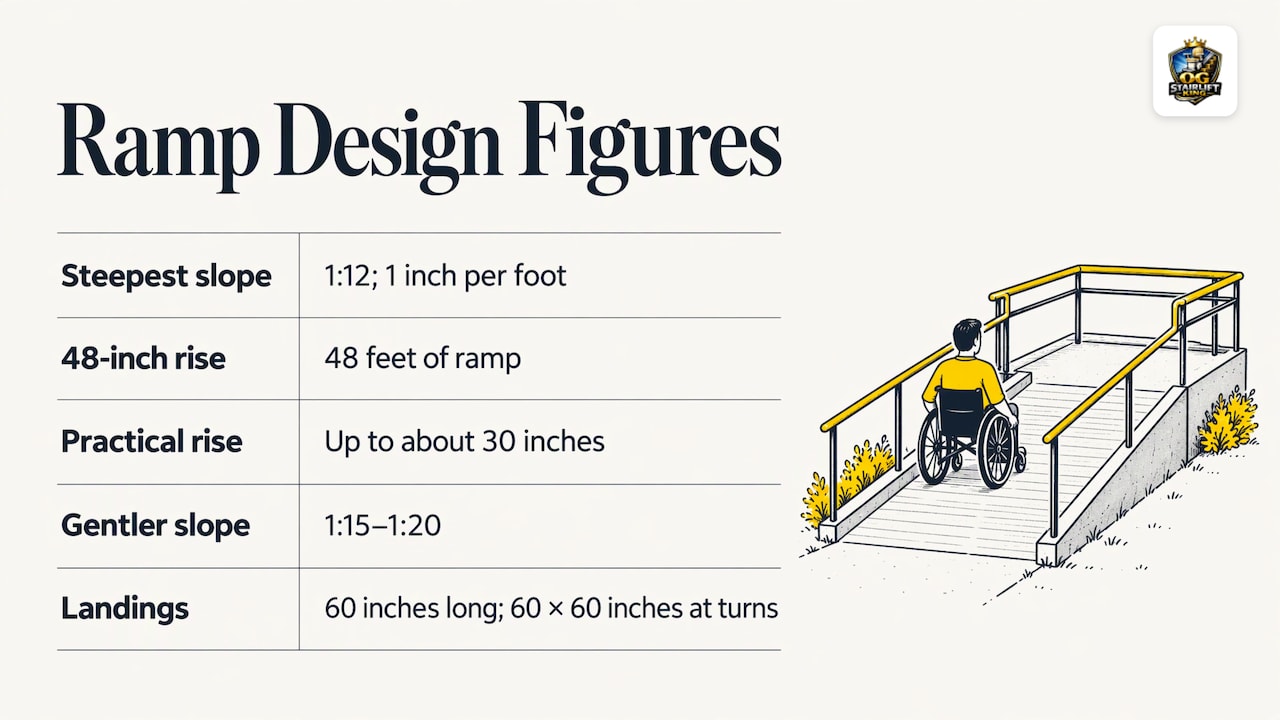
Ramps can be built quickly and inexpensively for low rises. A 2024 remodeling guidebook from the Mayors’ Caucus notes that rises above 30 inches take a lot of construction, and that outdoor ramps need ongoing leaf, snow and ice removal, painting and repairs. For a house with an interior staircase, a ramp is rarely an option at all.
Platform lifts and home elevators
A platform lift is a small enclosed or open platform that rises vertically. It takes less area than a ramp and can carry a person with or without a wheelchair, so the user never has to leave the chair. A home elevator does the same across several floors, for every member of the household.
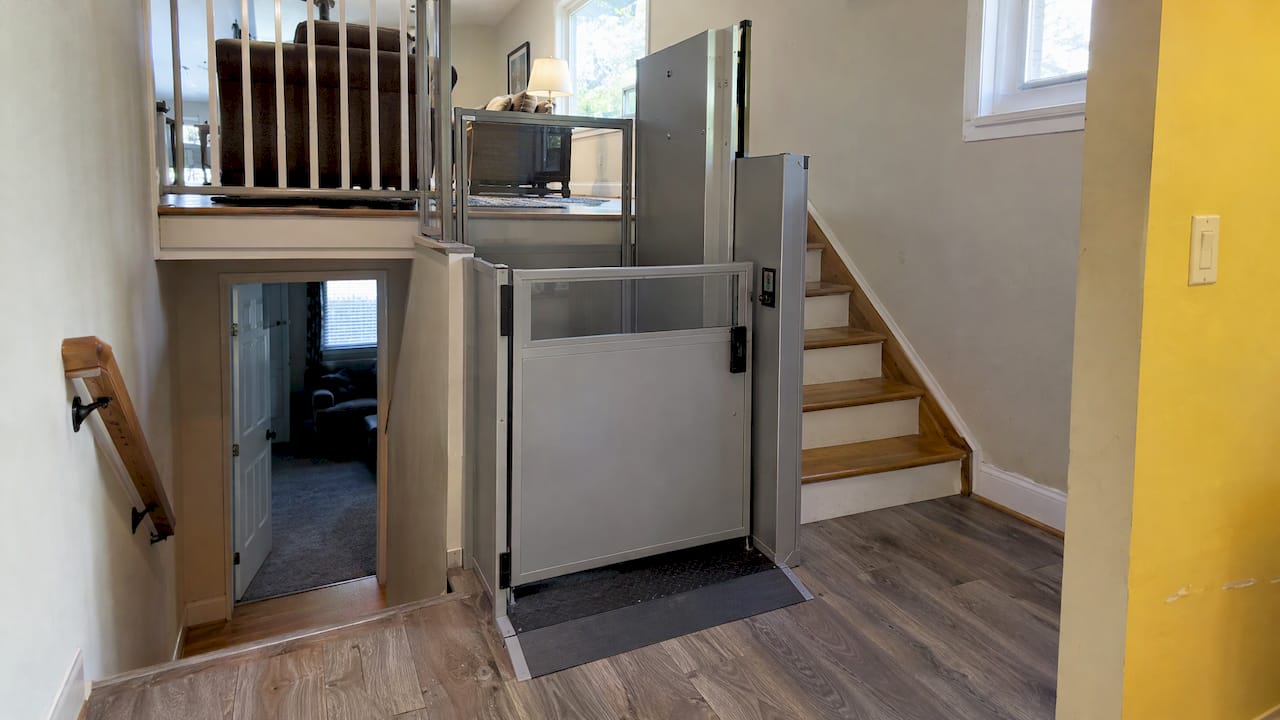
Both need more from the house than a stairlift. Through-floor and vertical lifts need space at both levels and alterations to the property, and they must be installed by a qualified engineer and tested regularly. For a wheelchair user who cannot transfer, they are often the right answer. Where the user can transfer, the cost and building work are hard to justify when a stairlift fits.
Rebuilt stairs
Sometimes the stairs themselves are the problem: tall risers, shallow treads, no handrail. The Alaska guide describes rebuilding stairs with 4 to 6 inch risers and deeper treads, which needs a footprint of 12 to 16 feet compared with 37 feet for an ADA ramp. Good accessible stairs also have handrails on both sides and edges that contrast in color so steps are easy to see. The HUD publication Residential Remodeling and Universal Design notes that single-color schemes make step edges harder to tell apart.
This works for people who can still climb with less effort. It does not help someone who can no longer climb at all, or who tires halfway up.
Stairlifts: using the stairs you already have
A stairlift is a powered chair on a rail fixed to the stairs. The folding seat and footrest tuck away so others can still use the staircase. Straight rails are significantly cheaper than curved ones, and a stairlift can usually be installed in a day. The Alaska guide recommends a stairwell at least 36 inches wide for most chair lifts, battery backup that returns the chair to floor level in a power cut, and a folding seat that doesn’t block travel.
That last point matters on shared stairs. In common-use stairways, local building or fire departments often disallow chair lifts because a power failure could block the width needed for fire exit. Property managers should confirm this with the local authority before planning a lift in a shared stairwell.
We sell and install stairlifts from several manufacturers, so the model can be matched to your stairs rather than the other way round. You can see the ranges we supply, including Stannah stairlifts, Bruno stairlifts and Handicare stairlifts. For stairs with turns or unusual shapes, we also design bespoke stairlifts.
Who each option suits
Wheelchair users. A platform lift or home elevator avoids transferring out of the chair. Stairlifts with a wheelchair platform exist, but they take up a lot of room on the stairs and many home staircases are too narrow.
Seniors who can still walk short distances. A stairlift is usually the simplest fix. The user needs to get on and off the seat, stay secure while riding and operate the controls. Stairlifts may be unsuitable for people with severe uncontrollable movements, dizziness or reduced cognitive ability, according to a UK disability charity factsheet. The same factsheet warns that assisted transfers at the top of stairs can be very dangerous. If the user cannot transfer independently, ask an occupational therapist or your doctor to assess them before choosing equipment.
People recovering from an injury or surgery. Temporary needs call for a quick, removable fix. A stairlift can be taken out when it is no longer needed, and the factsheet notes hiring may suit short-term recovery. Our guide to difficulty climbing stairs covers when a lift helps.
Families. If you are helping a parent stay in their own home, the stairlift caregiving guide walks through the daily routine and what to expect.
Property managers. Rules differ by building type. Under the 2010 ADA Standards, an elevator is not required in an altered facility under three stories or under 3,000 square feet per story, with exceptions for shopping centers, health care providers and transit stations. Local codes can go further, so check with your building department. Some states regulate lifts under their own elevator codes.
How to choose: a short checklist
- Measure the rise. Under about 30 inches, a ramp is realistic. Above that, look at lifts.
- Measure the stairwell. At least 36 inches clear width suits most chair lifts.
- Decide whether the user can transfer. If yes, a stairlift. If not, a platform lift or elevator.
- Check the needs ahead. If mobility is likely to change, say so at the assessment so the design allows for it.
- Plan for service. Any lift needs regular maintenance, and a power backup keeps it usable in an outage.
On the last point, a lift is only as good as its upkeep. We provide regular maintenance and emergency repair, and our pages on battery replacement and what to do when a stairlift stops working cover the common problems.
Make the stairs themselves safer
Whatever you choose, the staircase still matters. Good lighting, handrails and visible markings on the first and last steps reduce the risk of falls. Rugs on stairs and narrow, high steps are common hazards. Our accessible home renovations guide sets out what to change first.
Get a stairlift assessed for your home
If your stairs are the obstacle and the user can sit and transfer, we can come to your home, measure the staircase and talk through the options. We offer free home assessments with a full consultation, and we design and install stairlifts for homes and commercial properties across the New York area, including New York City and Long Island. Start at stairliftkinginc.com.
We pair installation with repair and maintenance, so the same team that fits your stairlift looks after it.
FAQ
What is the cheapest alternative to a staircase?
For a small rise, a ramp can be inexpensive. For an existing staircase, a straight stairlift is significantly cheaper than a curved one and usually cheaper than a through-floor lift, because no building alterations are normally needed. We give a quote after a free home assessment.
Can a wheelchair user use a stairlift?
Only with a wheelchair platform model, which takes a lot of room on the stairs. Many home staircases are too narrow. Platform lifts and through-floor lifts let a user stay in the chair.
How wide do stairs need to be for a stairlift?
The Alaska guide recommends about 36 inches for most chair lifts. A UK factsheet gives a minimum of roughly 29 inches for comfortable seated use. The rail, seat width and footrest all matter, so measure with the model in mind.
Is a stairlift permanent?
No. A stairlift can be removed if it is no longer needed, which makes it practical for recovery after an injury or operation as well as long-term use.
Does a stairlift work in a power cut?
Models with battery backup can return the chair to floor level during an outage. Ask about backup at your assessment, and see our page on battery replacement for upkeep.