Difficulty Climbing Stairs: Causes, Safety Steps and When a Stairlift Helps

If stairs have become hard, the cause is usually a mix of weaker muscles, painful joints, poorer balance or breathlessness, and the fix is usually a mix too: see a doctor about anything new, make the staircase itself safer, and, when the stairs stay a daily struggle, take the climb out of the day with a stairlift. A stairlift carries you up and down while you sit, so every floor of your home stays yours. We design, install, repair and maintain stairlifts, and a free home assessment is where we start.
This guide is for older adults, people recovering from surgery or injury, and the families and property managers who worry about them. It explains why stairs get harder, which symptoms need a doctor, what makes a staircase safer, and how to decide when a stairlift is the right step.
TL;DR
- Trouble on stairs has many causes, including arthritis, poor balance, weak grip, high blood pressure, fear of falling and slower walking.
- New or worsening breathlessness, chest pain, dizziness or leg swelling on stairs needs a doctor, and severe symptoms mean calling 911.
- Handrails on both sides, good lighting, clear steps and well-fitting shoes cut the risk of a fall right away.
- When stairs are an ongoing problem, a stairlift removes the climb and the fall risk that comes with it.
- We offer free home assessments, custom installation, emergency repair and regular maintenance for stairlifts.
Table of Contents
- Why stairs get harder
- When trouble on the stairs needs a doctor
- Making the stairs safer today
- How to tell stairs have become an ongoing problem
- What a stairlift does for you
- Getting the right stairlift
- Our free home assessment and installation
- Keeping a stairlift working
- For families and property managers
- FAQ
- Sources
Why stairs get harder
Stairs ask more of your body than flat walking. You lift your knees higher, push your whole body weight up against gravity, and balance on a narrow footing at every step. When one part of that chain weakens, the whole movement gets harder.
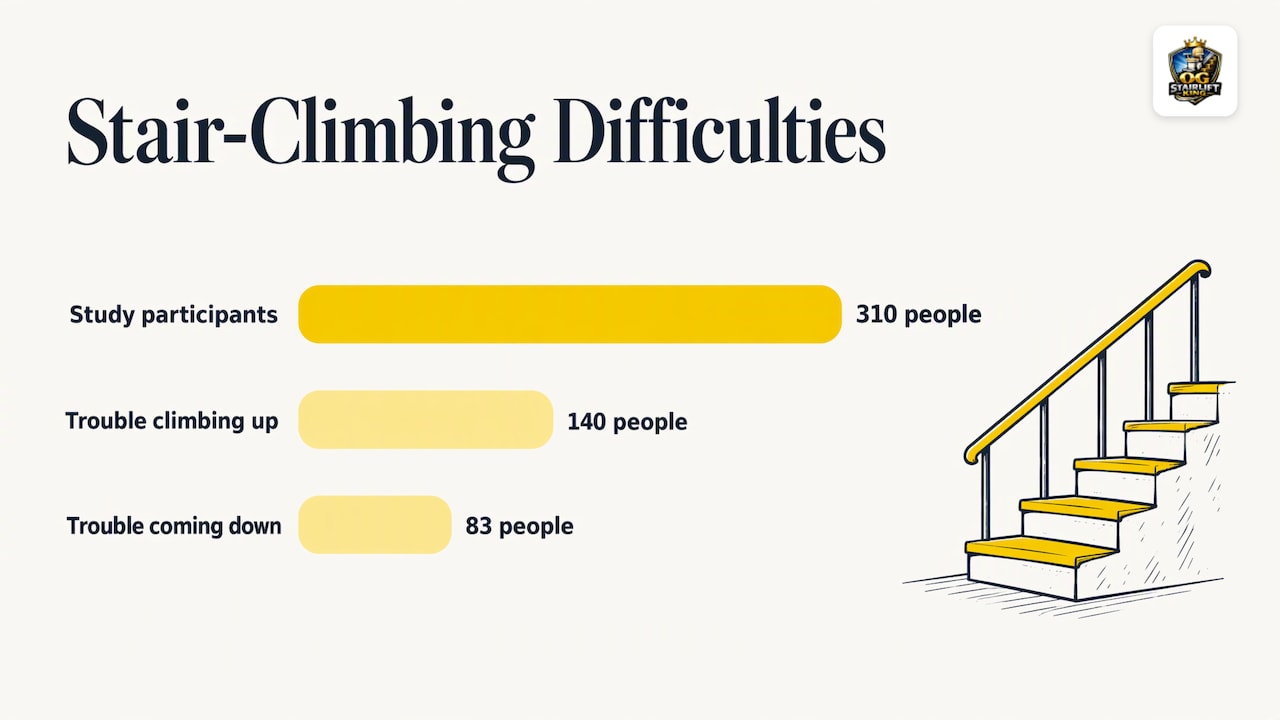
A study of 310 older adults without a formal disability (average age 80) shows how varied the causes are. Of those, 140 reported trouble climbing up and 83 trouble coming down. Difficulty going up was linked to high blood pressure, arthritis, depressive symptoms, poor balance, reduced grip strength and neurologic gait problems. Difficulty in both directions was linked to leg pain when walking, fear of falling and slower walking speed. The authors also note that vision, heart and joint disease, memory and neurologic conditions, and the stairs themselves, including their design and lighting, all play a part.
That last point matters for families. The same person can manage one staircase and struggle on another, because steep, dim or narrow steps raise the demand.
Going up versus coming down
Climbing up tires the legs and lungs. Coming down is where many falls happen. New Zealand’s building research body BRANZ states in its stair design bulletin that most stair falls occur while descending, and that young children and the elderly are the most at-risk groups. If you feel fine climbing but nervous going down, take that seriously.
Why it matters beyond the stairs
In that same study, people who had trouble in both directions had much higher odds of limiting their everyday activities (odds ratio 6.58) than people with trouble in only one direction. In practical terms, a staircase that is hard both ways often means rooms upstairs, such as the bedroom or the only full bathroom, start to feel out of reach.
When trouble on the stairs needs a doctor
Some causes are about strength and joints. Others are about the heart, lungs or nerves, and those need a medical check. These are not decisions to make alone or with a stairlift company: they belong to your doctor.
Schedule a visit with your doctor if:
- Breathlessness on stairs is new, getting worse, or happening at lower levels of activity than before. Northwestern Medicine advises this, and says the key question is whether it is the same as it has always been or has changed.
- You notice leg swelling, palpitations or dizziness along with the breathlessness. The same source says to seek prompt care for these combinations.
- Hip pain gets worse, you have had a fall or hip injury, or the pain makes daily activities like walking or climbing stairs difficult.
Call 911 or go to an emergency department if:
- You have sudden or severe shortness of breath, especially with chest pain or pressure. Northwestern Medicine gives this guidance.
- You faint, have dizziness that does not go away, or suddenly cannot walk or move. MedlinePlus, from the US National Library of Medicine, lists these as emergency signs.
- Chest or upper-belly pain or pressure lasts 2 minutes or more, or your heart races at rest with shortness of breath or faintness. Johns Hopkins Medicine cites the American College of Emergency Physicians for these.
If you are recovering from surgery or an injury, follow your surgeon’s or physical therapist’s instructions about stairs. Your care team can tell you how much weight you can put on the leg and how long to expect a limit.
Making the stairs safer today
Whether or not you add a stairlift, a safer staircase protects everyone in the house. The following checks come from safety guidance and take little time.
- Handrails on both sides. Living Made Easy, a UK independent living resource, recommends secure handrails on both sides. The UK Health and Safety Executive says they should contrast with their surroundings and sit at a suitable height. BRANZ’s bulletin gives 900 to 1000 mm (roughly 35 to 39 inches) as the height for accessible stairs, with the rail continuous from top to bottom and extending 300 mm (about 12 inches) past the top and bottom steps.
- Light switches at the top and bottom. Living Made Easy recommends switches at both ends. BRANZ sets a minimum of 100 lux for private stairs, so a bright bulb at each end is worth the small cost.
- Clear the steps. Remove loose rugs, shoes, laundry and clutter, and keep stair coverings in good repair.
- Mark the edges. The HSE recommends clearly marked step edges and good slip resistance at the leading edge. In a study of public-building stairways, low contrast on tread edges was among the most common unsafe design practices, found in 19% of buildings, and missing or inadequate handrails was the most common at 41%.
- Wear shoes that fit. Well-fitting shoes help, and so does keeping one hand free for the rail.
- Cut the number of trips. Australia’s Stop Falls at Home fact sheet suggests planning ahead to reduce stair trips, carrying items in a backpack to keep your hands free, resting when you need to, and keeping a walking aid at the top and bottom.
Bad knees and weak legs
With knee pain, technique helps. Physical therapist advice reported by CreakyJoints is to lead with your stronger leg going up and your other leg going down, to use the handrail so some weight shifts off your knees, and to place your whole foot on each step.
Research points the same way. A 2014 systematic review of 13 studies found that in people with knee osteoarthritis, better stair-climbing ability goes with stronger leg muscles and less knee pain. A physical therapist can build a program around your own knees and your own staircase.
These habits lower risk, but they do not change the fact that each trip still requires a full climb. For a person who faces that climb many times a day, the next step is to remove the climb itself.
How to tell stairs have become an ongoing problem
One bad day on the stairs after a cold or a long walk is not the same as a pattern. Families often notice these signs first:
- Your parent pauses on the landing or holds the rail with both hands.
- They avoid the upstairs, sleep on the sofa, or stop using a bathroom on another floor.
- They descend one step at a time, or sit on the stairs to go down.
- You see bruises, near-falls, or a new fear of the staircase.
- A recovery from surgery or injury will take months, not days, and the bedroom is upstairs.
The Stop Falls at Home fact sheet names a stairlift as an option to consider when stairs are an ongoing issue. At this point, the question is not whether to give up the upstairs, but how to keep it safely.
What a stairlift does for you
A stairlift is a motorized chair or platform that rides along a rail fixed to the stairs. You sit, buckle in and travel from one floor to the next without lifting your body weight at all. That removes the exact demand that causes trouble: leg strength, knee load, breathlessness and the balance needed on each step.
For you, that means:
- Independence. You keep the bedroom, bathroom, laundry and living space across the whole home.
- Safety. There is no stepping, so no missed step, no turning on a narrow tread and no carrying a load up while holding the rail.
- Peace of mind for family. Relatives no longer have to listen for the stairs or arrange to be home.
- Support through recovery. For someone healing from a hip, knee or back procedure, a stairlift keeps a bedroom upstairs usable.
Features worth knowing about
Arthritis UK describes the main options. Stairlifts come in seat, perch (a stand-up support) and wheelchair-platform designs. Seats may be height adjustable and swivel to make getting on and off safer. Controls can be joysticks or rocker switches, and a good lift has sensors that stop it if something is in the way. The same page notes that walking aids should not be carried on the lift, so keep a second walking aid at the top and bottom of the stairs, as the Stop Falls at Home sheet suggests.
It also recommends getting an occupational therapist’s advice, a health professional who looks at how a person moves and lives at home, before you decide. If your doctor or therapist is already involved, their view of your needs is a useful guide for the assessment.
Curved stairs, narrow stairs and commercial buildings
Many people assume their staircase is too curved, too narrow or too long. Because we offer custom design, a staircase with turns or landings is part of the conversation, not a reason to stop. We design stairlift solutions for residential and commercial properties, which is useful to property managers responsible for accessibility in a multi-floor building. For commercial or shared-access stairs, the HSE guidance advises an assessment whenever mobility or balance puts someone at risk of falling, taking into account the views of the individual, care professionals and family.
Getting the right stairlift
We sell stairlifts from several manufacturers, so the choice is based on your staircase and your needs, not on one product line. You can read about the brands we carry on our pages for Acorn, Bruno, Handicare, Harmar, Savaria and Stannah, as well as our bespoke stairlifts.
Before any visit, it helps to gather a few answers:
| Question | Why it matters |
|---|---|
| Is the stair straight, or does it turn or have a landing? | Shapes the rail and the design of the lift |
| Who will use it, and can they transfer from a chair on their own? | Guides seat type, swivel and controls |
| Are there hand, arm or vision limits? | Guides controls such as a joystick or rocker switch |
| Is it for recovery or for long-term use? | Sets what the household needs over time |
| Does a family member or caregiver also use the stairs? | Affects how the lift is placed and parked |
These are the questions we cover in a free home assessment, along with a detailed consultation, so the proposal matches your home.
Our free home assessment and installation
The Original Stairlift King designs and installs custom stairlifts for homes and commercial properties. The process begins with a free home assessment and a thorough consultation, so a design is based on how the person actually moves through the house. That is also why we pay attention to how the lift fits into the look of your home.
If the staircase has become the hardest part of your day, you can book a free home assessment through our main page. We also serve communities across Long Island, with local pages for Cedarhurst, Hewlett, Inwood and Glenwood Landing.
Keeping a stairlift working
A stairlift is something you use several times a day, so it has to be dependable. We provide regular maintenance and emergency stairlift repair, so the lift keeps working for as long as you need it. A household that relies on a lift to reach the bedroom should know who to call if it stops, and that is the reason we offer both services alongside installation.
For families and property managers
If you are arranging this for someone else, involve them early. The HSE says an assessment should consider the views of the individual, care professionals and family, and the same principle works at home. Ask your relative what bothers them most: the pain, the fear, the fatigue or the risk of a fall. Then ask their doctor or therapist about any medical cause.
Property managers can use the same approach on a larger scale. Look at every staircase on the property for rail coverage, contrast and lighting, and identify which residents or visitors cannot manage steps. Public design standards give useful benchmarks, such as the City of Mississauga’s accessibility standards, which call for continuous handrails at an accessible height with at least 70% contrast against the background. Check your own local codes for the requirements that apply to your building.
FAQ
What causes trouble walking up stairs in older adults?
The causes are many: arthritis, poor balance, reduced grip strength, high blood pressure, depressive symptoms, neurologic gait problems and fear of falling all show up in research on older adults. Poor lighting and steep or narrow stairs make it worse. If the difficulty is new or getting worse, see your doctor.
How can I make stairs safer for a senior?
Install secure handrails on both sides, light the stairs with switches at the top and bottom, remove rugs and clutter, and make sure shoes fit well. Keep a walking aid at each end of the stairs and cut down on trips. If stairs are still an ongoing problem, a stairlift removes the climb entirely.
What can I do about bad knees on the stairs?
Use the handrail, put your whole foot on each step, and lead with your stronger leg going up. A physical therapist can set up a strengthening plan, since stronger leg muscles and less knee pain go with better stair climbing in knee osteoarthritis. If you face the stairs many times a day, a stairlift spares your knees the load.
When should I worry about shortness of breath on stairs?
See a doctor if breathlessness is new, getting worse, or appearing at lower effort, especially with leg swelling, dizziness or palpitations. Call 911 for sudden or severe breathlessness, or if it comes with chest pain or pressure.
How do I start getting a stairlift?
Book a free home assessment with us. We look at your staircase, talk through your needs and recommend a design, with installation, maintenance and emergency repair available afterward.