Carrying Groceries Upstairs: Safer Ways and When to Add a Lift

The safest way to carry groceries upstairs is to carry less at a time, keep one hand free for the handrail and never block your view of the steps. If that routine no longer feels safe, the problem is the staircase, not your packing, and the lasting fix is a stairlift that takes the climb out of every trip. Below you will find practical ways to pack and carry, what stair carts can and cannot do, the signs that stairs have become unsafe, and how a stairlift changes grocery day for seniors, people recovering from injury and the families who worry about them.
TL;DR
- Keep one hand free for the handrail on every trip, and never carry anything that blocks your view of your feet.
- Split the load into small, evenly weighted bags, or use a backpack or a cross-body bag, and make several short trips.
- Stair carts and delivery services reduce the load, but they do not make the stairs themselves safer for you.
- Dizziness, a recent fall, leg weakness or needing to rest halfway up are signs to change the stairs, not just the bags.
- We offer free home assessments, and we install, repair and maintain stairlifts, so you can ride the stairs instead of climbing them.
Table of Contents
- Why groceries and stairs are a risky mix
- How to pack and carry groceries upstairs more safely
- Stair carts and dollies: what they do and where they stop
- Other ways to cut down on stair trips
- Signs the stairs, not the groceries, are the problem
- How a stairlift changes grocery day
- Who this matters for
- Our approach: assessment first, support after
- A simple plan you can start this week
- FAQ
Why groceries and stairs are a risky mix
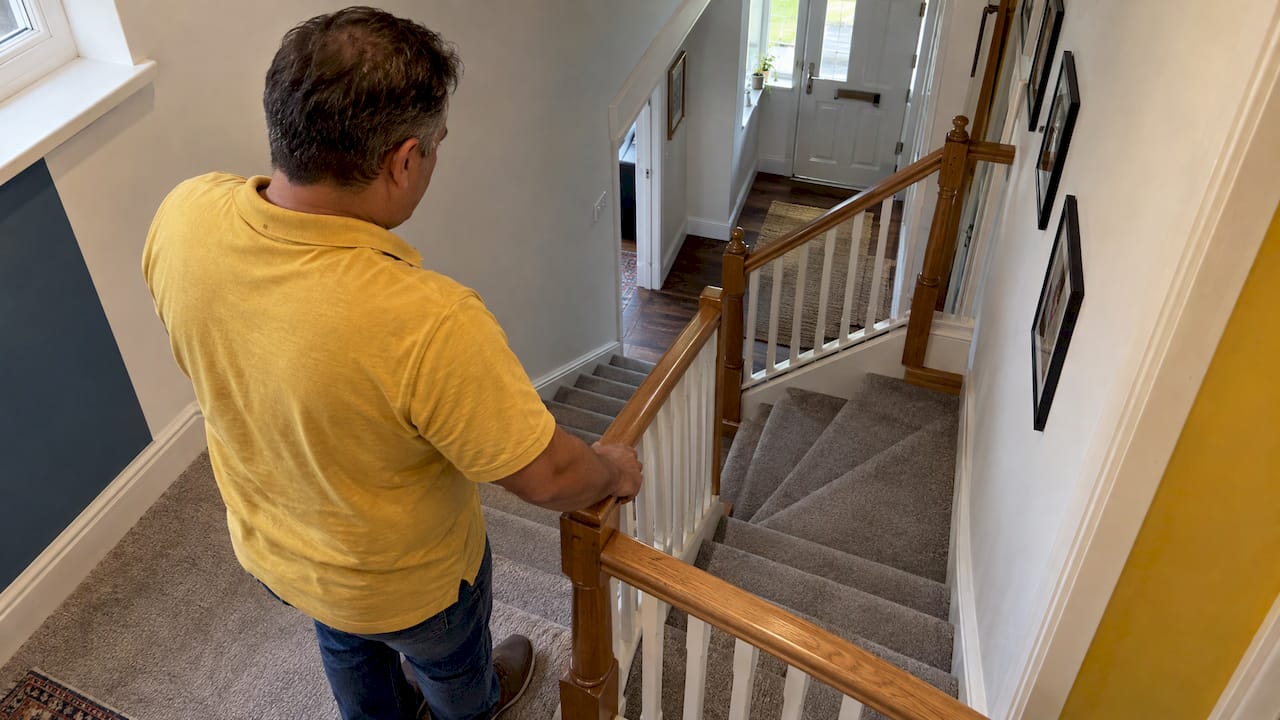
A grocery trip seems routine, and that is exactly why it causes accidents. You come in tired, hands full, perhaps with a door to push open and a bag handle slipping. On stairs, three things go wrong at once: your balance is asked to do more, your hands are busy, and your view of the steps is partly blocked.
Falls are the real stakes. The CDC reports that more than one in four adults aged 65 and older falls each year, and stairs are a common place for it to happen. Public health and housing agencies in the US, Canada and the UK give the same core advice about carrying things on stairs: keep one hand free to hold the handrail, do not carry anything that blocks your view of the steps, and do not rush.
Two details matter for the people who read this page most:
- Weight is not the only issue. A light but bulky bag of bread and paper towels can block your sightline as much as a heavy one.
- Going down is often harder than going up. Housing guidance for more vulnerable stair users says both hands should be available for the rail, especially on the way down. That applies when you carry the empty bags and the recycling back to the car as well.
How to pack and carry groceries upstairs more safely
If you are generally steady on your feet and want to make grocery day easier, these habits do the most.
Use more bags, with less in each
Overfilled bags are the usual culprit. Health service guidance on household tasks suggests spreading items between bags and not over-packing them. Ask the cashier or the bagger to fill bags only part way. A bag you can lift easily with one hand is a bag you can carry up with the other hand on the rail.
Put the weight on your body, not your fingers
A backpack or a shoulder bag worn diagonally across the chest keeps both hands free for the rail. Put the heavy items such as cans, jars and bottles in the pack and carry only the delicate things, such as eggs and bread, in your hand. If you need both hands for something, it is too much for the stairs in one go.
If you do use two bags, make them equal in weight, one on each side, so you are not pulled off center. Another option from NHS household-task guidance is a single bag held in your arms close to your body. Only do that if the bag does not hide the steps from you.
Stage the load at the bottom
Bring the bags in from the car and set them at the foot of the stairs. Then carry them up in several trips rather than one heroic one. Put perishables up first, then everything else. Resting at the top between trips is a good sign of sensible planning, not weakness.
Do not hang bags from a cane, crutch or walker
Walking sticks and crutches are not designed to carry loads. Hooking a bag over a handle can make you unstable. Trays and baskets on a walking frame should only carry light items, because extra weight disrupts the balance of the aid. If you rely on a mobility aid to get around, the stairs are the place where a different solution is needed, not a clever bag.
Make the stairs themselves work for you
Before you carry anything, check the staircase:
- Light switches at both the top and the bottom of the stairs.
- Handrails on both sides, running the full length of the stairs. Safety checklists from the CDC and Canadian housing authorities recommend this, and also suggest extending the rail past the top and bottom steps.
- No loose or uneven steps, and a non-slip surface.
- Nothing stored on the steps. The “take it up next time” pile is a classic trip hazard.
Stair carts and dollies: what they do and where they stop
People searching this topic often find folding carts with special wheels designed to climb steps. They work on a simple principle: clusters of wheels rotate over the edge of each step as you pull the cart up behind you. They can be useful for moving groceries, laundry and boxes when the person doing the moving is steady on their feet.
Know their limits before you rely on one:
- Lower capacity on stairs. Manufacturers typically rate a cart for a lighter load on stairs than on flat ground, so a full week of shopping may exceed it.
- Staircase suitability. Many makers warn against using them on hollow wooden stairs, and tight, narrow or winding staircases can make them awkward.
- You still climb. A cart moves the groceries. It does nothing for your balance, your knees, your breathing or your risk of a fall. Pulling a cart behind you also occupies a hand that would otherwise be on the rail.
That last point is the important one. A cart solves a freight problem. If your real difficulty is the climb, a cart leaves that problem exactly where it was.
Other ways to cut down on stair trips
Planning ahead can take a lot of strain out of the week. NHS guidance on managing after injury or surgery suggests asking a friend or family member to carry items, using supermarket delivery, and shopping little and often instead of in one big trip.
Some practical versions of that:
- Delivery or pickup. Grocery delivery to the door still leaves the stairs between the door and your kitchen if you live upstairs, so pair it with a helper or a lift.
- Family or neighbor help. A standing weekly arrangement is better than asking each time.
- Smaller, more frequent shops. A basket’s worth instead of a trunk’s worth.
- Heavy items last. Water cases, litter and pet food are the biggest offenders. Have them delivered separately or ask for help with those alone.
If you are recovering from surgery, follow your surgeon’s instructions. For example, NHS guidance after neck surgery says to limit heavy lifting for at least six weeks and to avoid two-handed tasks such as carrying shopping bags upstairs. Your own care team will tell you what applies to you.
Signs the stairs, not the groceries, are the problem
It can be hard to admit that the stairs have changed. These signs suggest it is time to look at a more lasting solution:
- You hold the rail with both hands, or you pull yourself up with it.
- You stop to catch your breath or rest your legs partway up.
- You have fallen, or nearly fallen, on the stairs.
- You feel dizzy, faint or unwell when climbing. Health guidance is blunt on this: avoid the stairs if you feel that way.
- You have started avoiding the upper or lower floor, or you leave shopping on the ground floor overnight.
- A family member worries every time you go up with bags.
Canada’s national housing agency frames the decision as a simple question: do you have any difficulty using the stairs inside your home? If the answer is yes, it pairs fixes such as better lighting and handrails with moving the bedroom and laundry to the main floor, or installing a chair lift. The goal it describes is keeping your independence, not just adding equipment.
A physiotherapist or occupational therapist can assess how you manage stairs, including your stability, strength and balance. Ask your doctor for a referral if you are unsure about your ability. We also have a longer guide on difficulty climbing stairs, its causes, safety steps and when a stairlift helps.
How a stairlift changes grocery day
A stairlift is a powered chair that travels on a track fixed to the stairs, carrying you from one floor to the other while you sit. Straight staircases take a straight track, and staircases with turns or landings need a curved track made to fit them.
Here is what that means for groceries:
- You no longer climb. Your energy, your knees and your balance are spared for the rest of the day.
- Your hands stay safe. You ride seated and hold on to the unit, instead of balancing bags on a staircase.
- Smaller loads become easy. Carry a light bag on your lap while you ride, within the limits of the unit and the guidance of your installer, and keep heavier items for a helper or a separate delivery.
- The routine stays yours. You can still shop for yourself, which is the point of keeping independence.
A stairlift is not suitable for everyone. For example, a person with severe uncontrollable body movements, dizziness or reduced cognitive ability may need a different approach. That is why a proper assessment of you and your staircase comes first, ideally alongside advice from your doctor or therapist.
Straight or curved: what shapes the fit
The shape of your staircase decides the design. A straight run is the simplest. A turn, a landing, a narrow stair or a tight hallway calls for a custom track. Fit also depends on who will use it: someone who can sit and stand easily needs different features than someone with limited leg strength or one who needs extra support. This is why one-size-fits-all rarely works.
Choosing between brands
No single brand suits every staircase, which is why we sell stairlifts from several manufacturers: Acorn, Bruno, Handicare, Harmar, Savaria, Stannah, Otolift and Hawle. For staircases that do not fit a standard model, we also design bespoke stairlifts. Because we are not tied to one manufacturer, the recommendation starts from your stairs and your needs.
Who this matters for
Seniors and recovering patients
If you are older, or you are recovering from a fall, surgery or injury, the stairs may be a temporary or permanent barrier. A lift lets you stay in a home you know instead of rearranging your life around the ground floor.
Families
If you are worried about a parent or relative, a conversation about groceries is often an easier way in than a conversation about aging. Ask who carries the bags, how many trips it takes and whether they rest halfway. The answers tell you whether it is time for a home assessment.
Property managers
If you manage residential or commercial buildings, stairs can be a real accessibility barrier for tenants and visitors. We design and install stairlifts for both residential and commercial properties, so a manager can talk to one provider about the install, repair and upkeep.
Our approach: assessment first, support after
We start with a free home assessment and a thorough consultation, because the right stairlift depends on your staircase, your routine and the person who will ride it. From there we design and install a custom solution, whether it is a straight run or a more complicated staircase, with attention to how it looks in your home as well as how smoothly it runs.
A stairlift is something you rely on every day, so what happens after installation matters too. We provide regular maintenance to keep it running well, and emergency repair when something goes wrong. If your lift stops mid-week with groceries waiting at the bottom, our guide on what to check and when to call if a stairlift is not working walks through safe first checks.
We have location pages for communities across Long Island, including Old Bethpage and Roosevelt.
If the stairs have become the hardest part of grocery day, book your free home assessment with The Original Stairlift King. We will look at your staircase, talk through your needs and show you which options fit.

A simple plan you can start this week
- Walk the stairs once as if you were carrying bags. Note where you hesitate, rest or reach for the rail.
- Fix the basics. Lighting at both ends, a clear staircase, and a rail on each side.
- Change how you shop. Smaller loads, backpack for the heavy items, a standing arrangement for the heavy ones.
- Talk to your doctor or therapist if you have had dizziness, a fall or any change in strength or balance.
- Book an assessment if the stairs still feel like the hard part. Seeing your staircase in person is the quickest way to learn what is possible.
FAQ
What is the safest way to carry groceries up the stairs?
Carry one light load at a time, with one hand always free for the handrail. Use a backpack or a cross-body bag for heavy items and make several trips rather than one. Never carry anything that hides the steps from your view.
Do stair-climbing carts really work?
They can move groceries and boxes up a standard staircase, but they usually carry less on stairs than on flat ground and are not meant for every kind of step. They also leave your own climb unchanged. If the stairs themselves are the problem, a stairlift addresses that directly.
When should I stop carrying groceries up the stairs myself?
Stop when you feel dizzy, faint or unwell, when you have had a fall or near fall, or when you need to rest halfway up. Those are signs the stairs need a different solution. Mention them to your doctor, and consider a home assessment.
Can I carry groceries on a stairlift?
A light bag on your lap is commonly manageable for many riders, but your lift has its own weight limit and operating instructions, and you must be able to hold on and stay seated safely. Heavier shopping is better handled by a helper or delivery. We can go over this with you during your assessment.
Does a stairlift fit a curved or narrow staircase?
Yes, staircases with turns, landings or limited width can be fitted with a track designed for them. We design custom solutions for these cases, and a free home assessment is the way to find out what suits your stairs.
Recommended
- Difficulty Climbing Stairs: Causes, Safety Steps and When a Stairlift Helps
- Albertson New York Stairlift Installation, Stairlifts Dealer, Stairlifts Repair, Maintenance
- Brooklyn New York Stairlift Installation, Stairlifts Dealer, Stairlifts Repair, Maintenance
- Lloyd Harbor New York Stairlift Installation, Stairlifts Dealer, Stairlifts Repair, Maintenance