Stairlift Not Working? Safe Checks and When to Call

If your stairlift has stopped moving, the cause is usually power, charging or a safety sensor doing its job. Start with four quick checks: the key switch, the wall outlet, the charge point and anything blocking the track. If the lift still won’t move, stop there. Anything past those checks, including opening covers or forcing the seat, belongs to a trained technician. Our team at The Original Stairlift King handles emergency stairlift repair for homeowners, families and property managers.
This guide is for the person who lives with the lift or looks after someone who does. It explains what to check, what the beeps and numbers mean, what to do if the lift stops with someone on it, and how to avoid a repeat.
TL;DR
- Most “dead” stairlifts have a simple cause: key switch off, power unplugged or tripped, or the lift parked away from its charge point.
- Beeps and display numbers are fault messages. Your model’s owner’s manual lists what they mean, and the meanings differ between brands.
- Never try to wind, lift or pull a person out of a stuck lift yourself. If they are in distress or at risk, call 911.
- Batteries and charging cause many stops. Keep the lift plugged in and have it inspected on a regular schedule.
- If the safe checks don’t restore movement, book a repair visit rather than opening the lift up.
Table of Contents
- Why a stairlift stops moving
- Safe checks when your stairlift won’t move
- What the beeps, lights and numbers mean
- If the stairlift stops with someone on it
- Why it keeps happening: battery and charging habits
- What the technician does that you can’t
- Our repair and maintenance service
- Quick reference: before you call
- FAQ
- Sources
Why a stairlift stops moving
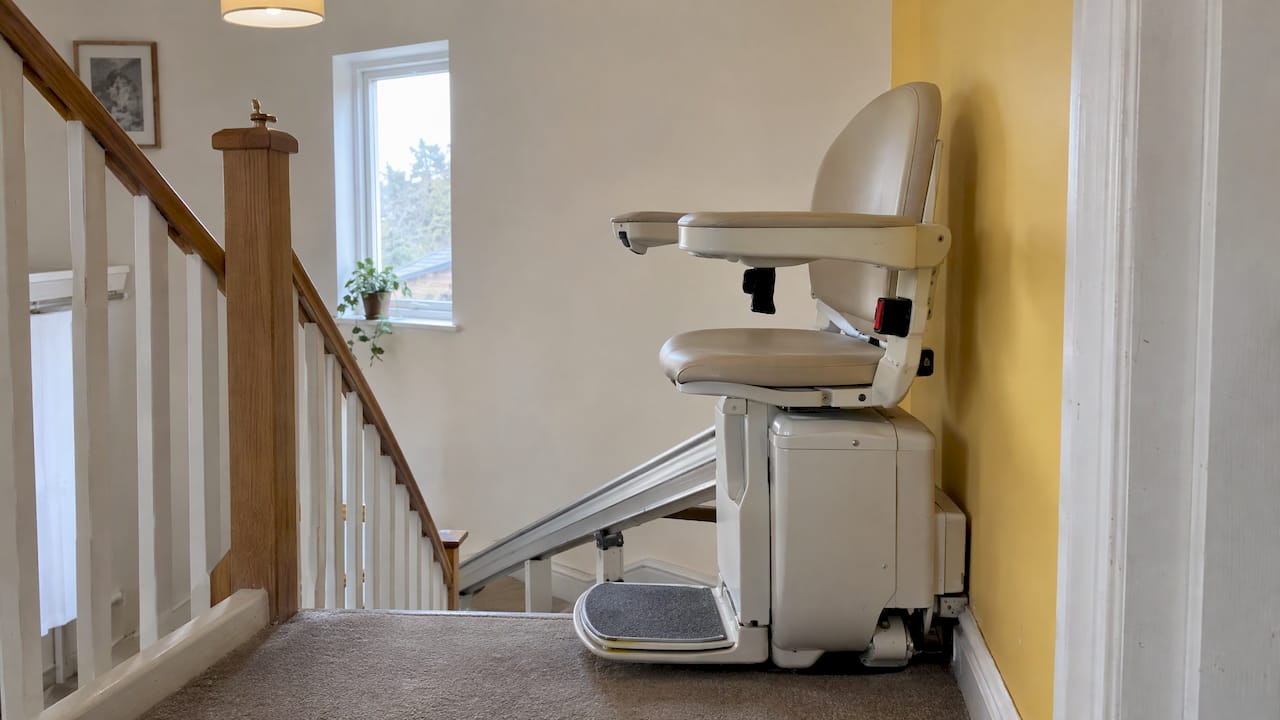
A stairlift is a battery-powered chair on a rail. The batteries are kept topped up by charging contacts at one or both ends of the track, or by a plug. The chair also carries sensors that stop it when something is wrong: a footrest that has hit an object, a seat that is swiveled, a seat belt or armrest that is not set, or an obstacle on the rail.
That design explains most stops. The lift is either not getting power, has not charged, or has detected something it treats as unsafe. Each of those leaves a different clue: no lights at all, a beep, or a number on the display.
Safe checks when your stairlift won’t move
Work through these in order. Each one needs no tools and no covers removed. Stop the moment anything looks damaged, smells burnt or makes a grinding noise.
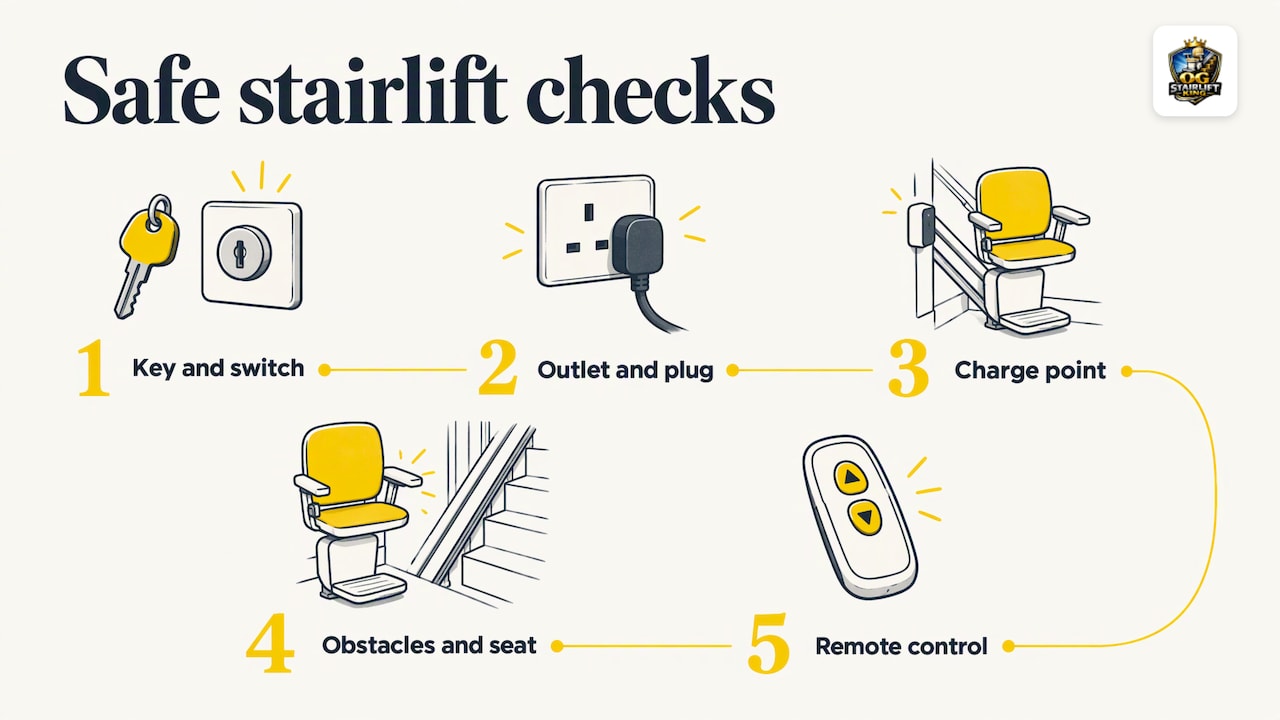
1. The key switch and on/off switch
Many lifts have a key switch that turns the lift on or off. It sounds too simple, but a key turned the wrong way or removed is a very common reason for a lift that seems dead. Turn it to the on position and press the controls again. Some lifts also have a battery isolator switch, which is a separate off switch for the battery. An owner’s manual for a curved stairlift tells you to check the mains plug, key switch and battery isolator switch when no lights are lit.
2. The wall outlet and the plug
Check that the charger is firmly in the outlet and that the outlet has power. A lamp or phone charger works as a quick test. Look at your breaker panel for a tripped breaker. If the outlet is switched from a wall switch, make sure that switch is on. A cleaner or a family member may have unplugged the lift to use the outlet.
3. The charge point
Most stairlifts only charge when they are parked at a charge point. If the chair stopped partway along the rail, or someone left it off the charge station, the batteries may drain. One owner’s manual for a stairlift says an intermittent beep for 30 seconds, repeating every 5 minutes, means the lift has been stopped off the charge station. Another curved stairlift manual says a lift not in the correct position at a charge point beeps for 15 seconds and shows a “2” on the display, and that the lift won’t work if the batteries are flat. The fix in that case is to move the lift to a charge point or put the plug in the socket.
Also note that batteries do not charge when the lift is switched off, according to the same stairlift manual from the Harmar line. If you turned the lift off for a long holiday, leave it plugged in and on afterward and give it time to recharge.
4. Obstacles, swivel seat and safety edges
Look along the whole staircase. A shoe, a laundry basket, a pet toy or a dropped walking aid on the stairs can stop the lift. The safety covers around the footrest and the carriage are built to stop the chair when they touch something. The curved stairlift manual says that if the lift travels in only one direction and the display shows “4” or “6”, an obstacle sits between the lift and the stairs. You move the lift in the opposite direction and remove the obstacle. The same manual says a display of “0” with no travel means the emergency stop has been pressed, and turning the emergency button releases it.
If the seat is swiveled, the footrest is folded or the seat belt or armrest is not in its riding position, many lifts will refuse to move. Return everything to the riding position, then try again.
5. The remote control
If the lift responds to the buttons on the chair but not to the call or send remote, the remote is the problem. A remote with a dead battery or one that has been dropped will not send a signal. Replace the remote’s battery by following the instructions for your model, then try again.
If you have done all five checks and the lift still doesn’t move, stop. The next steps involve parts that carry electrical current and moving rails.
What the beeps, lights and numbers mean
Codes are not universal. A “2” on one brand means something different on another, so always read the codes in your own manual. The examples below show why.
| Signal | Example meaning | Brand and model type |
|---|---|---|
| Beeps for 15 seconds, display “2” | Lift not at a charge point; move to the charge point or plug in | Curved stairlift manual |
| Display “0”, no travel | Emergency stop pressed; turn the emergency button to release | Same manual |
| Display “1” | Low batteries | Platinum Curve manual |
| Display “2” | Not charging | Same manual |
| Display “4” or “6” | Safety covers activated; lift reverses away from the obstruction | Same manual |
| Display “7” | Batteries very low | Same manual |
| Single long beep | Minor fault, such as swiveled seat, edge safety detected, footrest, overload or low battery voltage | SL300 manual |
| Repeating beeps by count | Major fault; the count tells a technician which fault it is | Same manual |
The last row matters most. On that SL300 model, major-fault beep counts include 1 for a runaway condition and 2 for no power, while counts of 3 to 8 point to conflicting footrest, obstruction or stop-switch pairs. You do not need to memorize these. Count the beeps, write the number down with the model name, and give that information to the technician. It speeds up the diagnosis.
One more thing worth knowing: the same number can mean different things on a straight lift and a curved lift, and between brands. Do not search for a code online and assume the first answer fits your lift. Find the model name on the label on the chair or the rail, and use that model’s manual.
If you can’t find your manual
The model name and serial number are usually on a label on the chair frame or the carriage. If the lift was installed by us, tell us the brand and the approximate install date and we can identify the model. We sell and service Stannah, Bruno, Handicare, Harmar, Savaria and Acorn stairlifts, among others from multiple manufacturers, so one visit covers whichever brand is on your stairs.
If the stairlift stops with someone on it
This is the situation that frightens families most, and the right response is calm and simple.
- Stay seated, belt fastened. Do not stand up on the stairs or try to climb out. A fall from a stairlift is worse than waiting.
- Check the obvious. If the person can reach the controls, they can look for a swiveled seat, a pressed emergency stop or something under the footrest. Do not ask them to reach over the rail or lean out.
- Do not wind or lift. Stairlift guidelines from a social housing provider state that manual winding should only be done by a trained engineer or rescue services, with the passenger seated and belted. They also state that engineers should not manually lift customers out of a non-working lift. If trained engineers are held to that standard, a family member should not try it.
- Call for help. Per the same guidelines, if the lift cannot be moved to a floor level and the user is in medical distress or at risk, call emergency services. In the US, that is 911. If the person is comfortable and not at risk, call a stairlift technician and stay with them while you wait.
Those guidelines are written for the UK, but the safety reasoning applies on any staircase: untrained attempts to move a lift with a passenger aboard can create dangerous situations.
Why it keeps happening: battery and charging habits
Battery trouble is behind a large share of stops, and it is the most preventable. The SL300 owner’s manual advises keeping the lift fully charged with the power supply plugged in continuously. It also says to replace batteries every 1 to 2 years, depending on usage, and to have a dealer inspect the lift every 1 to 2 years. Your model may differ, so use these figures as a pattern and your own manual for the exact interval.
A simple routine keeps the lift reliable:
- Park at the charge point after every ride, upstairs or down, wherever your model charges.
- Leave the lift switched on and plugged in, even if no one uses it for a few days, unless your manual says otherwise.
- Keep the staircase clear, including the rail edge and the area around the footrest.
- Note any change. A new beep, a slower ride or a jerk at the same spot every time is an early warning. Report it before it becomes a stop.
- Schedule regular maintenance so the batteries, charging contacts, sensors and rail are inspected before they fail.
Our regular stairlift maintenance covers exactly this kind of scheduled care, and it is a good fit for property managers who need several lifts to stay in service.
What the technician does that you can’t
Inside a stairlift are batteries, a drive motor, a circuit board and a gear-and-rack system, along with safety switches. The reasons to leave the covers on are practical:
- Electrical parts can be live even when the lift seems off.
- Safety switches that look “stuck” are usually protecting the rider. Bypassing one removes the protection.
- A fault that looks like a battery problem can be a charging contact, a board or a sensor. Replacing the wrong part wastes money and leaves the lift unreliable.
- Some models need a specific part number and setup after a repair.
A technician reads the fault pattern, tests the charging system and the sensors, and confirms the lift is safe to carry a rider before leaving. That last step is the point: a lift that moves is not always a lift that is safe.
When to call right away
Call for repair instead of retrying if you notice any of these:
- The lift stops in the same spot every time.
- It beeps in a repeated pattern after you have cleared obstacles and charged it.
- The display shows a code that comes back after you reset the lift.
- You see damaged cables, a cracked cover, a bent rail or a loose seat.
- Someone was on the lift when it stopped, even if it started again.
Our repair and maintenance service
The Original Stairlift King installs and services stairlifts for homes and commercial properties. Our offer includes emergency stairlift repair, regular maintenance, and sales of stairlifts from multiple manufacturers. If your stairlift isn’t working and the safe checks haven’t solved it, request an emergency stairlift repair and tell us the brand, the model if you know it, and any beep count or display number you saw.

We also serve New York locations, including Coram, Cedarhurst and Glenwood Landing. If your lift is old and keeps failing, we offer free home assessments with a thorough consultation, so you can look at a replacement or a custom stairlift design for a staircase that has changed, such as after an injury or a move.
Quick reference: before you call
Having this information ready makes the first conversation faster:
- The brand and model name from the label.
- Whether the stairs are straight or curved.
- What happened just before the stop: a power cut, a spill, a bump, a long period unused.
- Whether there are beeps, and how many, or a number on the display.
- Whether the lights are on, and whether the key switch and plug are in place.
- Whether anyone was on the lift when it stopped.
FAQ
Why has my stairlift stopped working?
The most common causes are a key or battery switch turned off, power lost at the outlet, a drained battery because the lift was not on its charge point, or a safety sensor triggered by an obstacle. Check those first. If they don’t explain it, the cause is inside the lift and needs a technician.
Why is my stairlift not moving but beeping?
The beep is a fault message. Depending on the model, it can mean the lift is off its charge point, the batteries are low, or a footrest or safety edge has touched something. Manuals list different beep patterns for minor and major faults, so count the beeps and read your own model’s manual.
Can I reset my stairlift myself?
You can switch it off and on with the key switch and check the plug, the charge point and the safety covers. That is the safe limit. If a code returns after those steps, the lift has a fault that needs a technician.
What should I do if the stairlift stops while someone is sitting on it?
Keep them seated with the seat belt fastened and do not try to move the lift or lift the person out. If they are in distress or at risk, call 911. Otherwise, call for stairlift repair and stay with them until help arrives.
How often should a stairlift be serviced?
One owner’s manual recommends a dealer inspection every 1 to 2 years and battery replacement every 1 to 2 years depending on use. Check your own manual for your model’s interval, and arrange regular maintenance so the visit is not left until a breakdown.