Stairlift for Family Caregiving: A Practical Guide

A stairlift can take the most dangerous part of a day out of caregiving: the trip up or down the stairs. It works best when your loved one can still sit, buckle in and run the controls on their own, and when the staircase has room for a track. A free in-home assessment settles the fit, and our team at The Original Stairlift King offers one, so you are not guessing from photos or measurements.
This guide is for the son, daughter, spouse or friend who helps someone at home. It covers when a stairlift makes sense, how to check safety, what the process looks like, and how to keep the lift working for years.
TL;DR
- A stairlift suits a person who can transfer to a seat, fasten the belt and operate the controls, and who needs help with stairs because of age, balance, pain or recovery from injury.
- Ask a physician or occupational therapist to assess the person first. Then have a stairlift specialist assess the staircase.
- Staircase shape decides the type: straight, curved or outdoor. Curved and outdoor lifts cost more because the rail is custom-built or weatherproofed.
- Plan for upkeep from day one: yearly inspection, and a clear plan for what to do if the lift stops.
- We offer free home assessments, custom installation, emergency repair and regular maintenance, all under one roof.
Table of Contents
- Why stairs become a caregiving problem
- When a stairlift helps, and for whom
- Straight, curved or outdoor: which type fits the stairs
- How to check the home before you buy
- What a stairlift cost looks like in the U.S.
- From assessment to installation: the steps
- What to do if the stairlift stops
- Helping someone on the stairs while you wait
- Is a stairlift enough, or do you need more?
- How we help family caregivers
- FAQ
Why stairs become a caregiving problem
Stairs ask a lot of the body at once: strength in the legs, balance, vision, joint comfort and the nerve to keep going when tired. When any of those slips, the family often starts to hover. You walk behind your mother on the way up. You carry laundry so your father can hold the rail. You listen for a thud from upstairs.
That works for a while, then it wears everyone down. Caregivers risk back strain from hands-on lifting and steadying, and the person being helped can feel like a burden for needing an escort to their own bedroom. A stairlift moves the person between floors while they sit, which cuts out the step-by-step effort and the near-misses that come with it.
If you are still figuring out whether stairs are really the issue, our guide to difficulty climbing stairs, its causes and when a stairlift helps walks through the signs.
When a stairlift helps, and for whom
A stairlift is a powered chair that rides a rail fixed to the stairs. It fits several caregiving situations:
- Older adults aging in place. Balance, vision, arthritis or general fatigue make stairs risky, but the person wants to stay in the home they know.
- Recovery from injury or surgery. After a hip fracture, knee replacement, or a hospital stay, stairs are often the first obstacle. A lift gives access to the bedroom and bathroom during recovery and afterward if strength does not fully return.
- Progressive conditions. If mobility is expected to decline slowly, a lift bought early keeps options open.
- Family members who live in the home. Spouses and adult children who are older themselves, or who have their own back problems, can stop being the human handrail.
The rider must be able to use it
The key test is simple. The person should be able to get into and out of the seat without trouble, fasten the safety belt and operate the controls. That takes some physical ability and some clear thinking. The National Council on Aging makes the same point in its stairlift buying guidance, and it suggests that a physical or occupational therapist can judge whether a lift suits the person.
If the person cannot sit steadily, cannot follow the steps to operate the lift, or needs hands-on lifting at the top and bottom, a standard seated stairlift may not be the right tool by itself. That is a question for the therapist, and for us during the assessment, where we can talk through other designs and what the home allows.
Get the clinical view first
The U.S. Department of Housing and Urban Development, in its 2022 stair lift tip sheet on adapting existing homes, recommends that a physician and an occupational therapist complete an assessment of daily activities before an automatic stair lift is chosen. An occupational therapist looks at how the person moves through their day, where falls are most likely, and what equipment would actually reduce risk. Bring that report to the stairlift assessment. It saves time and keeps the decision focused on the person, not the product.
Straight, curved or outdoor: which type fits the stairs
The staircase decides the type more than the rider does.
| Type | Best for | What drives cost |
|---|---|---|
| Straight | A single flight with no turns | Typically the least expensive, because the rail is a standard length |
| Curved | Stairs with a turn, landing or bend | Custom-made or modular rail, number of bends, labor |
| Outdoor | Porch, deck or exterior entry steps | Weatherproofing and custom installation, typically the highest cost |
A few practical points follow from this:
- Straight lifts are usually the quickest to install, often in a day.
- Curved lifts are built to the exact shape of your staircase, so measurements matter. This is where a careful in-home visit pays off.
- Outdoor lifts carry the same core safety features as indoor ones, such as a swivel seat, key switch, sensors and seat belt, but are built for weather and need a suitable power supply.
- Design options include seated lifts, perch or standing models for people who cannot bend their knees well, and platform styles for wheelchair users.
We sell lifts from several manufacturers, so the recommendation follows the staircase and the rider, not one catalog. You can browse the Stannah, Handicare, Bruno, Acorn, Savaria and Harmar pages to see what each line offers. For stairs that no off-the-shelf rail fits, our bespoke stairlift option is designed around the home.
How to check the home before you buy
Walk the stairs with a tape measure and these questions. They are the same ones a good assessor will ask.
- Width. Is there enough room for the track and seat while others can still pass? Guidance from New Zealand’s disability support agency uses at least 1 meter (about 3 feet 3 inches) of stair width as a benchmark for safe passing beside the track. Narrower stairs can still work with a lift that has a folding seat and footrest, but the details matter.
- Shape. Do the stairs curve, have a landing, or split? That points to a curved rail.
- Space at the top and bottom. Is there a clear spot to step on and off safely, away from doors that swing into the landing?
- Time horizon. Will the person live here for at least a couple more years, and will they be able to use the lift independently for that long? If the answer is yes, the investment usually makes sense.
- Power and wiring. Where is the nearest outlet? Outdoor installations need a supply that meets electrical safety requirements.
- Other people in the house. The track and folded seat take up some of the stairs. Arthritis UK notes that the track reduces usable stair space and the seat or footplate can be a hazard, so think about grandchildren, pets and other adults.
Other people in the home
Children should not play on a stairlift, and any child who rides should be supervised by an adult. Fold the seat and footrest after every use so they do not become a trip hazard. If pets use the stairs, keep their path clear of the footplate. A good installer will talk through these habits at handover.
What a stairlift cost looks like in the U.S.
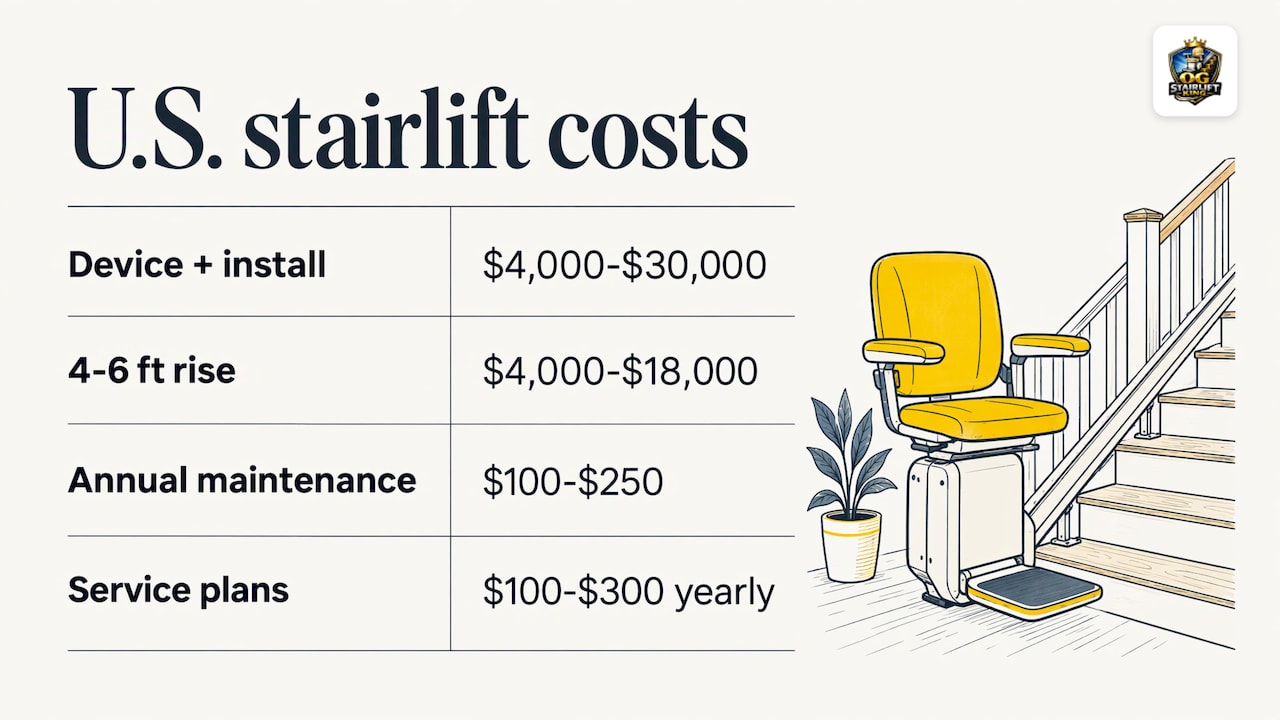
Prices vary with the staircase, the model and the installation. The HUD tip sheet gives typical U.S. ranges: $4,000 to $30,000 for a device and installation depending on lift height, and $4,000 to $18,000 for lifts covering a rise of 4 to 6 feet. It lists annual maintenance of $100 to $250. The National Council on Aging puts yearly service plans at $100 to $300, covering inspection of the rail, motor, gearbox and controller.
We do not publish prices, because the real number depends on your stairs. A straight flight and a curved staircase with two turns are very different jobs. That is why we start with a free assessment and thorough consultation, so the quote reflects your home.
Will insurance or Medicare pay?
Original Medicare generally does not pay for stairlifts, since they are treated as home modifications, not medical equipment. Some state programs, Medicaid waivers, Veterans Affairs home improvement grants and local aging agencies may help in specific cases, and rules vary by state and by person. Your local Area Agency on Aging is the right first call to learn what applies where you live. Ask the agency or your plan administrator before you commit, and keep any therapist’s letter that documents the need.
From assessment to installation: the steps
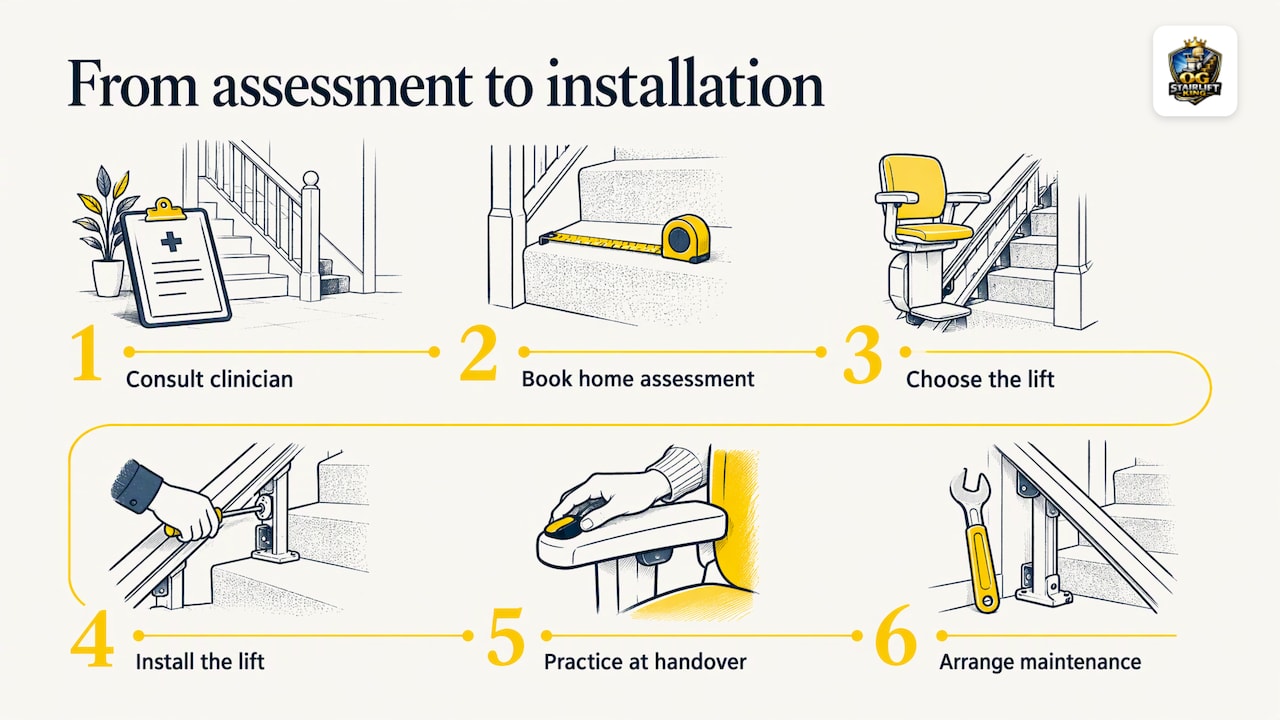
Step 1: Talk to the clinician
Ask the doctor or occupational therapist whether a stairlift suits the person, and what they must be able to do to use it. If the person is leaving the hospital, raise stairs with the discharge team early, since stair practice and equipment planning are often part of recovery support.
Step 2: Book a home assessment
A proper assessment means someone in your home, measuring the stairs, checking the landings and talking with the rider. We provide free home assessments with a full consultation. Having the person who will ride the lift present lets us check seat height, reach to the controls and how comfortably they transfer.
Step 3: Choose the lift
This is where design, brand and features come together: swivel seat, power folding, remote calls for the top and bottom, and how the track sits against the wall or the stairs. We design the installation around the staircase and also care about how it looks in the house, since a lift that fits in gets used.
Step 4: Installation
Once the order is confirmed, a certified technician installs it, typically within days to weeks of the order. Straight lifts can often go in within a day. Curved rails take longer because they are built to measure.
Step 5: Handover and practice
Before the installers leave, the rider should use the lift several times, with the family watching. Practice buckling the belt, using the controls, swiveling the seat at the top and folding it away. Everyone who might help should know how to use the call buttons and the key switch.
Step 6: Set up maintenance
Book regular maintenance at installation, not after the first problem. Yearly inspection of the rail, motor and electronics catches wear early. We provide regular maintenance as well as emergency repair, so one team that already knows your lift can handle both. Our stairlift service and installation page outlines what we offer.
What to do if the stairlift stops
Even a reliable lift will occasionally stop. Plan for it before it happens.
- Keep a phone on the upper floor, especially if the person is alone at times. Arthritis UK recommends this for people living by themselves in case the lift is out of service.
- Check the simple causes first: the lift may not be on its charging point, a safety sensor may be blocked, or the key switch may be off. Our guide to safe checks and when to call for a stairlift that is not working lists them in order.
- Never try to repair the motor, rail or electronics yourself.
- If the person is stuck on the stairs or the lift, call emergency services if there is any risk of injury or if you cannot help them safely.
- Agree on a backup plan: a bedroom or bathroom on the main floor for a few days, or a second person who can help.
For repairs, we offer emergency stairlift repair, so a breakdown does not leave the household stranded.
Helping someone on the stairs while you wait
Until a lift is in, or when it is out of service, stair help needs care. The therapy team should advise on technique when the person’s ability has changed after an injury, illness or hospital stay. Hospital therapy guidance generally recommends a sturdy handrail, clear steps and good lighting, and stair practice with a therapist when needed.
In general:
- Keep the stairs clear of clutter, shoes and loose rugs, and light both ends.
- Make sure there is a secure handrail, ideally on both sides.
- Stay on the downhill side, one step below when going up and in front when going down, as the therapist shows you, since technique depends on the person’s condition.
- Do not take a person’s weight on your own. If they cannot manage with light support, stop and call the therapist.
A stairlift is meant to replace this effort, not add to it.
Is a stairlift enough, or do you need more?
A stairlift is the right answer when the person can transfer to a seat and use the controls. Some families reach a point where the person needs hands-on help to transfer, or where the staircase is too narrow or too complex. A therapist’s advice and an honest conversation at the assessment will tell you. Our consultations look at the whole picture of the staircase, the rider and the household, not just the lift. The same goes for property managers who need accessibility for tenants or residents in multi-level buildings: we design for both residential and commercial properties.
How we help family caregivers
We design and install stairlifts for homes and commercial properties, and we sell lifts from multiple manufacturers so the recommendation fits your stairs. A free home assessment and thorough consultation come first, then installation, regular maintenance and emergency repair. We serve New York locations such as Glenwood Landing and Inwood.
If you are caring for someone and stairs are becoming the hard part of the day, start with a conversation about your home. Contact The Original Stairlift King to arrange your free home assessment.
FAQ
How do I know when it is time for a stairlift?
Look for signs such as holding the rail with both hands, resting halfway, avoiding the upstairs, a near-fall, or a caregiver who is bracing every time. Recovery from surgery or a fracture is another trigger. A therapist can confirm, and a home assessment shows what would fit.
Can a stairlift be used by someone with dementia or weak balance?
The rider must be able to sit steadily, buckle the belt and operate the controls, so the answer depends on the person. Ask their physician or occupational therapist before you buy. If a standard seated lift is not suitable, they can advise on the next steps.
Does Medicare cover a stairlift?
Original Medicare generally does not cover stairlifts. Other help, such as state or Medicaid programs, veterans’ benefits or local aging agencies, may apply in some cases. Call your Area Agency on Aging and your plan before ordering.
How long does installation take?
Once the lift is ordered, installation is typically scheduled within days to weeks. A straight lift can often be installed in a day. A curved lift takes longer because the rail is built to the shape of your stairs.
What maintenance does a stairlift need?
An annual inspection of the rail, motor, gearbox and controller is typical, and U.S. service plans commonly run roughly $100 to $300 a year. We offer regular maintenance and emergency repair, so the same team can look after your lift over time.