Stairs After Knee Replacement: Safe Technique and Timeline

Most people are asked to practice stairs with a physical therapist within days of knee replacement, often before leaving the hospital. The rule that keeps you safe is simple: up with the good leg, down with the operated one, one step at a time, holding a handrail. If your staircase is still too much after that, a stairlift takes the climb off your knee while it heals. We install them, and we can assess your home for free.
This guide covers the timeline, the exact technique with and without crutches, how to set up your home, which warning signs matter, and how to decide whether a stairlift belongs in your recovery plan. Your surgeon and physical therapist set your personal limits. Everything here is general guidance to use alongside their instructions.
TL;DR
- Stair practice usually starts in the hospital or in the first days at home, guided by your physical therapist. You are typically cleared to leave once you are “safe on stairs.”
- Going up, lead with the non-operated leg. Going down, lead with the operated leg and your crutch or cane. Take one step at a time and hold the rail.
- Cut your trips: many programs suggest limiting stair use to about once a day early on and setting up a first-floor bed if you can.
- Call your surgeon for rising pain or swelling, a hot or draining incision, fever, or calf pain. Chest pain or trouble breathing means the emergency room.
- If your stairs are steep, long or hard to manage, a properly fitted stairlift lets you move between floors without strain. We offer free home assessments.
Table of Contents
- When can you start using stairs after knee replacement?
- How to go up and down stairs after knee surgery
- Precautions that matter in the first weeks
- Warning signs: when to get help
- Getting your home ready for stairs
- When a stairlift makes sense after knee surgery
- How we help
- A simple plan for the first two weeks
- FAQ
When can you start using stairs after knee replacement?
Sooner than most people expect. Modern recovery programs get you out of bed within hours of surgery. A 2026 clinical practice guideline in the journal Physical Therapy recommends starting physical therapy, including early mobilization, within 24 hours of a total knee replacement. Hospitals that follow these programs often have you standing and walking on the day of surgery.
Stairs come next. Typical patterns look like this:
| Stage | What usually happens |
|---|---|
| Day of surgery to day 1 | Out of bed, walking with a walker or crutches. Some same-day-discharge programs have you trial a few steps. |
| Days 2 to 3 | The physical therapist practices stairs with you if your home has them. |
| Discharge | Many hospitals require you to be safe on stairs before you go home. |
| First 2 weeks | One step at a time, with a rail and a walking aid. Trips kept to a minimum. |
| Weeks 3 to 6 | Physical therapy adds step-ups and controlled step-downs to rebuild strength. |
| Weeks 6 to 12 | Many people manage stairs with support, then more normally as strength returns. |
These are typical ranges, not promises. Recovery depends on your surgery, your strength before the operation, your pain control and your surgeon’s protocol. Walking up a flight at day three does not mean you are “ahead,” and needing a rail at week eight does not mean you are behind.
If you had a different knee procedure, such as an arthroscopy or ligament repair, the same up-and-down technique usually applies, but timing differs. Ask your surgeon which restrictions you have, especially if you are told to limit weight on the leg.
How to go up and down stairs after knee surgery
The memory aid used by hospitals in the US and Canada is “up with the good, down with the bad.” The strong leg does the lifting going up. The operated leg goes first going down, so the strong leg lowers your body weight in a controlled way.
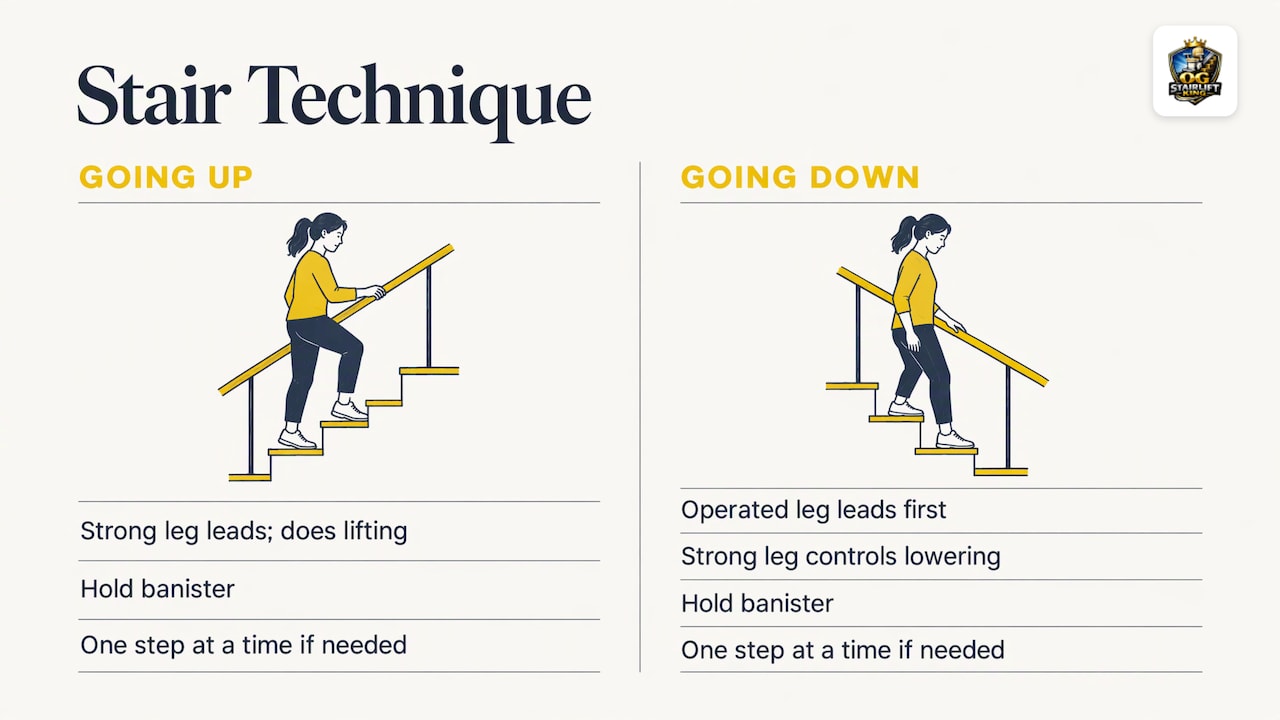
MedlinePlus, the US National Library of Medicine’s patient resource, gives the same advice: step up first with the leg that was not operated on, step down first with the operated leg, and hold the banister. It adds that you may need to go one step at a time until your muscles get stronger.
Going up with a handrail and one crutch or cane
- Stand close to the bottom step. Hold the rail with one hand and keep your crutch or cane in the other hand.
- Step up with your non-operated leg. Straighten it fully.
- Bring the operated leg up to the same step, along with your crutch or cane.
- Pause. Check your balance before the next step.
- Repeat. Both feet land on each step before you move on. Do not alternate feet.
Going down
- Stand at the top edge, holding the rail.
- Place the crutch or cane on the step below first.
- Lower the operated leg to that step.
- Bring the non-operated leg down.
- Pause, check your balance, and repeat.
If you use two crutches and only one rail, the usual instruction is to put both crutches on the side opposite the rail, or one crutch under the arm away from the rail, whichever your therapist taught you. Follow what they showed you in person, because the correct version depends on your walking aid and which side the rail is on.
What the technique is protecting
Going down is the harder direction for most people. Your thigh muscle has to lower your body weight slowly, and after surgery that muscle is weak and sore. That is why the operated leg leads: it takes the smaller step while the strong leg does the controlled lowering.
A few habits make the difference:
- Take it slowly. Rushing is how stumbles happen.
- Keep your knee in line with your hip and second toe. Let the knee point straight forward, not drift inward.
- Avoid twisting or pivoting on the operated leg, including at the top and bottom of a flight.
- Wear flat, closed, non-slip shoes. Socks and slippers on stairs are a common cause of falls.
- Do not carry things. You need a free hand for the rail. A small backpack or a bag handed up by someone else works better than anything in your arms.
Avoid stairs altogether when you feel dizzy, lightheaded or unsteady, for example soon after pain medication. Sit down and wait it out.
Practicing before surgery
Many hospitals suggest learning the technique before your operation, even if your home has no stairs, because you may meet stairs at a friend’s house, a doctor’s office or a car park. Practicing on a low step with your therapist before surgery makes the first real flight afterward far less strange.
Precautions that matter in the first weeks
The guidance from hospitals is consistent about what to limit early on.
- Reduce trips. MedlinePlus suggests avoiding long flights of stairs during the first two months and limiting stair use to about once a day if you can. Plan your day so one trip up in the morning and one down in the evening covers it.
- Avoid steep stairs. Steep, narrow or open-backed stairs are harder to control, and early on you are advised to avoid going down them.
- Do not kneel on the operated knee until you are told it is healed.
- Do not twist or pivot on a planted foot.
- Check every handrail before surgery. It should be firm, continuous and on a side you can reach. Ideally there is one on both sides.
- Keep exercising. Stairs are not a substitute for your prescribed exercises. Your therapist’s program, including step-ups with a rail and slow step-downs from around three weeks in many clinics, is what rebuilds the strength that makes stairs easy.
Warning signs: when to get help
Some soreness and swelling are normal. Contact your surgeon’s office promptly if you notice:
- Pain, swelling or tenderness that gets worse and does not ease with elevation and ice
- Redness, warmth or pain in the lower leg or calf, especially at rest
- An incision that opens, bleeds heavily, or drains
- Signs of infection such as spreading redness, heat, or a fever (one Canadian hospital booklet lists above 38.5°C, about 101.3°F)
- A painful click, a sudden loss of movement, or sudden difficulty walking or putting weight on the leg
Chest pain or difficulty breathing needs the emergency room right away. Call 911.
A fall on stairs, even one that seems minor, is a reason to call your surgeon the same day.
Getting your home ready for stairs
Most stair problems after knee surgery are solved before you leave for the hospital. A checklist drawn from public hospital and MedlinePlus advice:
- Rails on every staircase. Install a sturdy handrail on all indoor and outdoor stairs, including a two- or three-step porch. If you can reach both rails, use both.
- A main-floor bed. If you can set up a bed and a bathroom option on the first floor for the first weeks, you may only need stairs a handful of times.
- Things within reach. Move medication, water, the phone, snacks and the remote to where you will actually be sitting.
- Clear the path. Remove loose rugs and cords, fix uneven flooring, and put night lights along the route to the bathroom and on the stairs.
- Light switches at both ends. You should never climb in the dark.
- Bathroom grab bars. Use bars that are screwed into the wall studs, not towel racks, which pull out of the wall.
- Arrange help. Have someone nearby for your first days at home, particularly the first time you do the stairs on your own.
The last point matters for families. If you are caring for a parent or spouse coming home, our guide to stairlift planning for family caregiving walks through who does what, and our piece on carrying groceries upstairs covers the hands-free habits that protect you and the person you care for.
When a stairlift makes sense after knee surgery
The techniques above work for many people with a short, well-railed staircase. A stairlift is worth considering when:
- Your bedroom and only bathroom are upstairs and you cannot set up on the main floor.
- The staircase is long, steep or curved, and the idea of climbing it daily for weeks is not realistic.
- You live alone, or the person who would normally spot you is not always home.
- You also have arthritis, balance issues, a weak other leg or heart or lung limits, so that even “up with the good” is tiring.
- You are recovering from a second knee or are heading into back-to-back procedures.
- You are a property manager or landlord with a resident who needs to remain in a two-story unit.
A stairlift is not just a short-term fix. Many people keep one long after the knee has healed, because the other joints, the next surgery or the next ten years make stairs a daily strain. The lift lets you move between floors seated, with no step-by-step effort, and it protects the operated knee from the load that your muscles are still rebuilding to handle. If you are weighing it up, our article on difficulty climbing stairs and when a stairlift helps shows how to read the signs.
Fit details that matter for a recovering knee
A knee that cannot bend or straighten fully changes what you need from a stairlift. These are the points worth raising in a home assessment:
- Seat height. You want to sit down and stand up without dropping or hauling. Check the seat height at both the top and the bottom landing.
- Swivel seat and sturdy armrests. A swivel seat turns you to face the landing so you step off straight rather than twisting. Firm armrests give you something to push up from.
- Footrest and leg room. Your leg should have room to rest in a comfortable position, which matters when the knee does not bend easily.
- Rail layout. A straight rail is simplest. On a staircase with a bend or landing, a curved rail cuts the corner, and it is worth checking where your knees sit relative to the wall or newel post on the turn.
- Perch or standing models. Some narrow staircases or stiff-knee situations suit a perch seat, where you lean rather than sit with a bent knee.
- Weight capacity. Standard models have a stated maximum, and heavy-duty options exist. This is confirmed at the assessment.
It is also worth planning how you get on and off the lift with your walking aid. Where you leave your crutches or cane at each end, and whether you need a second one at the top, is easier to arrange before installation than after.
How we help
We design, supply and install stairlifts for homes and commercial properties, and we back them with emergency repair and regular maintenance. Because we sell stairlifts from several manufacturers, including Stannah, Acorn, Bruno, Handicare, Harmar and Savaria, as well as bespoke stairlifts, the recommendation starts with your staircase and your recovery, not with one catalog.
If you or a family member is facing knee surgery, we offer a free home assessment with a detailed consultation. We look at the staircase, the landings and the way you will actually use them. Book your assessment with us before surgery if you can, so the lift is ready for your first week home.

We serve homeowners across New York, including Staten Island, and our service does not stop at installation. If a lift stops working, our guide on what to check when a stairlift is not working gives the safe first steps, and we handle emergency repair and ongoing maintenance so it keeps running smoothly.
A simple plan for the first two weeks
Here is how a sensible early recovery often looks when stairs are involved:
- Before surgery: install or check rails, move your bed or arrange a recliner downstairs, practice the technique, and arrange a stairlift assessment if the upstairs is essential.
- Hospital stay: practice stairs with your physical therapist. Ask them to watch you do the flight type you have at home: same number of steps, same rail side.
- Days 1 to 3 at home: use the stairs as little as possible, with someone nearby. One trip up, one trip down per day is a common target.
- Days 4 to 14: continue with your walking aid, one step at a time. Keep doing your home exercises, since that strength is what makes stairs easier.
- Weeks 3 and on: as your therapist adds step-ups and step-downs, the staircase becomes a training tool as well as a route. Follow their progression rather than your own sense of how you feel that day.
FAQ
How soon can I climb stairs after knee replacement?
Most people practice stairs with a physical therapist within the first few days, often before leaving the hospital. Climbing one step at a time with a rail and walking aid is typical for the first weeks. Many people manage stairs more normally somewhere between six and twelve weeks, but your surgeon sets the pace.
Which leg goes first on stairs after knee surgery?
Going up, lead with your non-operated leg. Going down, lead with the operated leg, with your crutch or cane going down first. Bring the other leg to join it on each step and hold the handrail throughout.
Is it bad to climb stairs too much after knee replacement?
Climbing stairs does not damage the implant, but early on your muscles are weak and your knee is swollen, so repeated trips raise the risk of a fall and can increase swelling. Hospital guidance suggests limiting trips to about once a day at first and avoiding long flights for the first couple of months.
Can I use a stairlift after knee replacement?
Yes. A stairlift lets you travel between floors seated, so you are not loading a healing knee on every step. Choose a seat height that lets you sit and stand easily, a swivel seat with firm armrests, and check how your legs sit on the turns. Our free home assessment covers these details.
Should I get a stairlift before or after surgery?
Before, if your bedroom or bathroom is upstairs and you cannot set up downstairs. Installation takes planning, and having the lift in place means you can go home from the hospital and move between floors from day one.