Stairlift Battery Replacement: Signs, Options and Who Should Do It

A stairlift battery that is wearing out gives warning signs well before the chair stops: beeping, shorter trips, a lift that stalls partway up. The safest fix is a professional replacement matched to your exact model, because the battery is only one part of a power system that includes the charger, the charging contacts and the wiring. Our technicians handle stairlift repair and regular maintenance, so a worn battery can be dealt with as part of a proper service visit instead of a guessing game with parts. This guide explains what the battery does, how to tell it is failing, what your replacement options are and how to keep the new one working for years.
TL;DR
- Most home stairlifts run on rechargeable batteries that top up whenever the chair is parked at a charging point. When they weaken, the chair beeps, slows or stops mid-staircase.
- A weak battery is not always the real problem. A dirty charging contact, an unplugged charger or a tripped outlet can look the same, so check these first.
- Replacement should match your model’s voltage, capacity and connectors. A mismatch can damage the lift or leave you stranded on the stairs.
- Parking the chair at the charge point after every ride is the single habit that extends battery life most.
- If your lift is already stuck or unsafe, call for emergency repair rather than trying to work it out yourself.
Table of Contents
- How a stairlift battery works
- Signs the battery needs replacing
- Check these before blaming the battery
- Your options when a battery fails
- Why the right battery matters
- What affects the cost
- Replacement parts beyond the battery
- Keeping a new battery healthy
- When the lift is out of action
- For property managers
- Get your stairlift checked or replaced
- FAQ
How a stairlift battery works
A stairlift looks like it plugs into the wall, but the motor is usually driven by batteries inside the carriage or chair. The household outlet feeds a charger, and the charger tops up the batteries. This design has a real benefit: if the power goes out, the chair still has enough stored energy to finish a trip, so you are not trapped upstairs or downstairs.
Most residential straight-rail models use sealed lead-acid batteries, often a pair of 12-volt units, though sizes and layouts differ by brand and model. Many lifts have a charging strip or contact points at the top and bottom of the rail, or at a set parking spot. When the chair rests there, it charges. If it is stopped anywhere else, it does not.
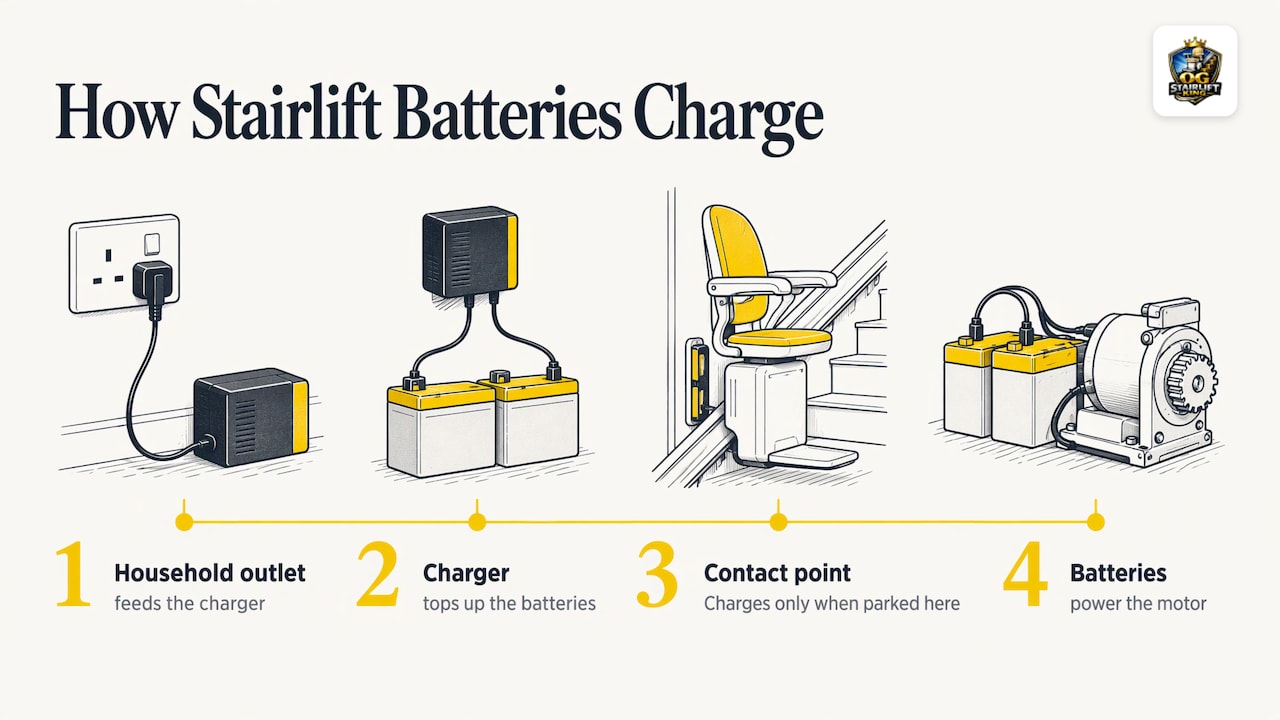
That last point explains most battery trouble. A chair left halfway up the rail, or parked where the contacts do not quite touch, drains and never refills. Over months, that shortens battery life far more than normal use does.
Why batteries wear out
Rechargeable lead-acid batteries lose capacity with age and with repeated deep drains. Three things speed that up:
- Skipping the charge point. Leaving the chair off its charging position means the battery never gets a full top-up.
- Long periods of disuse. A lift in a home where someone is away for weeks, or where the stairs are rarely used, can sit with an uncharged or slowly draining battery.
- Temperature extremes. An unheated garage or an enclosed unit in a hot space is harder on batteries than a normal indoor stairwell.
How long a battery lasts therefore varies from household to household. Rather than counting years, watch for symptoms.
Signs the battery needs replacing
Look for a pattern, not a single odd day.
- Beeping or an indicator light. Many stairlifts beep or show a warning when charge is low. If it persists after the chair has sat on the charger overnight, the battery may no longer hold a charge.
- Shorter runs. The chair makes one trip, then struggles on the second, or you notice it needs to sit on the charger far longer than it used to.
- Slowing or hesitating. The chair crawls on the incline or stops and restarts.
- Stopping partway. This is the one that gets people’s attention. A chair that halts between floors, especially with a person on it, needs a technician promptly.
- Dead after a power cut. If the lift worked fine until an outage and then would not move at all, the batteries may be too weak to act as a backup.
Two signs also point to a problem other than the battery: a lift that does nothing at all with no lights, or one that works only when you jiggle the plug. Those suggest a power supply or connection issue.
Check these before blaming the battery
A surprising number of “dead battery” calls turn out to be simple. Before you phone anyone, run through the checks in our guide on what to do when your stairlift is not working. In short:
- Confirm the charger is firmly plugged into a working outlet. Test the outlet with a lamp, and check whether a breaker has tripped.
- Make sure the chair is parked fully on its charging point and that nothing, such as a rug edge or a pet bowl, is stopping it from reaching it.
- Look for any indicator light on the chair or the rail and note what it shows.
- Check that the seat swivel, footrest and any safety sensors are in their normal positions, since an open or obstructed safety device can stop the chair even with a full battery.
- Wipe nothing down with liquids near the electrics, and never remove covers while someone is sitting on the chair.
If the chair is parked, charged and still failing, the battery or charging system needs a professional look. Note the brand, the model name on the label and the symptoms. That information speeds up any repair call.
Your options when a battery fails
There are really three routes, and they are not equal.
Option 1: Technician replacement during a repair or maintenance visit
This is the route we recommend. A technician confirms that the battery is genuinely the fault, and not the charger, a contact strip or a wiring fault. They fit a battery that matches your lift’s electrical specification, secure it properly and check that the chair charges and runs correctly afterward. The same visit is a chance to look over the rest of the lift: rail, swivel, seat belt, controls and safety sensors.
If your lift is stuck, or you have no way to get up or down your stairs safely, use our emergency stairlift repair service so the problem is handled right away.
Option 2: Replacing batteries as part of regular maintenance
If your chair is still working but the batteries are getting on, it is smart to deal with them on a schedule rather than waiting for a failure. Regular maintenance lets a technician check battery condition, charging contacts and the charger together, and replace what is weak before it strands anyone. This suits families managing a parent’s stairlift from a distance and property managers with several lifts to look after.
Option 3: Replacing the lift itself
Sometimes the battery is the smallest part of the problem. If a stairlift is very old, has had repeated faults, or no longer suits the person using it, a new unit can make more sense than another repair. Needs change: someone who could transfer easily onto a seat two years ago may now need a different seat, a longer rail or a footrest that folds differently.
We sell stairlifts from several manufacturers, and a free home assessment looks at your stairs and the user’s needs before recommending anything. You can browse the ranges we supply, including Stannah, Bruno, Savaria, Harmar and Acorn, as well as bespoke stairlifts for curved or unusual staircases. If your staircase has a turn, a landing or an outdoor section, a bespoke design is often the better starting point.
Why the right battery matters
Stairlift batteries are not interchangeable like household AA cells. Three specifications matter:
- Voltage. The motor and control board are built for a specific voltage. A wrong one can cause erratic behavior or damage the board.
- Capacity. Capacity, measured in amp-hours, affects how many trips the chair can make on a charge. A smaller battery may fit in the compartment and still leave you short of power on a long staircase.
- Connectors and physical size. Terminal types and the shape of the battery tray differ between models.
There is also the question of wiring order. Two batteries in a stairlift are typically connected in a particular arrangement, and reversing a connection can blow a fuse or harm the electronics. Lead-acid batteries also contain acid and heavy metals, so old units should never go in household trash. They are taken for recycling, which a technician arranges as part of the job.
This is why a model-matched replacement by a trained technician is the safer path than ordering a part online and fitting it on your own, particularly when the person depending on the lift cannot easily recover from a mid-stair failure.
What affects the cost
We do not publish set prices for battery work, because the cost depends on the lift in front of us. These are the factors that move it:
- The model and brand. Batteries differ in size, capacity and availability from one manufacturer to the next.
- The age of the lift. Older units may need additional parts, such as a charger or contact strip, replaced at the same time.
- What else is found. If the fault is the charger or wiring and not the battery, the repair is different, and the bill reflects that.
- Urgency. A stuck chair that needs immediate attention is handled differently from a scheduled maintenance visit.
When you call, have the brand, the model and the symptoms ready, and ask for the quote to cover the battery, labor and any related checks together. For lifts with repeated faults, ask the technician for an honest view on whether repair or a new unit serves you better over the next several years.
Replacement parts beyond the battery
People who search for battery replacement are often facing a wider list of worn parts. The ones that fail most often on a household stairlift are:
- Charger and charging contacts. If the chair sits on the charge point but never fills up, these are the first suspects.
- Seat belt and swivel mechanism. Frayed belts or sticky swivels are safety items and should be fixed promptly.
- Footrest and armrest sensors. These sensors stop the chair when something blocks it. A faulty one can stop the chair for no obvious reason.
- Remote controls. Worn buttons or dead remote batteries are common and often confused with a main battery failure.
- Rail-side components. Rack, rollers and end stops wear slowly and show up as noise or jerky travel.
One visit can cover several of these, which is usually less disruptive than separate calls. Our technicians work on stairlifts from the manufacturers we supply, and our maintenance and repair services are built to cover this range of issues.
Keeping a new battery healthy
A replacement battery lasts longest with a few easy habits.
- Park on the charge point every time. Make it a household rule, like closing a door. If several people use the chair, put a note by the rail.
- Leave the charger plugged in. Do not switch the outlet off at night or when you go out. If the outlet is controlled by a wall switch, tape over the switch.
- Run the lift when away. If the house will be empty for weeks, ask someone to ride the chair or at least make sure it is parked on its charger and the power is on.
- Keep the rail and contacts clean. Dust and pet hair on the charging strips can interrupt charging. Wipe lightly with a dry cloth with the power on and the chair empty, and do not spray liquids.
- Schedule a service. A yearly check lets a technician test the batteries before they become a problem.
When the lift is out of action
A lift that stops working is more than an inconvenience for someone with limited mobility or recovering from surgery. Plan for the gap:
- Do not climb the stairs unaided if the lift is your safety measure. Ask a family member to be present, or arrange a temporary sleeping and living space on one floor.
- Keep walking aids and handrails clear and well lit.
- Keep up your strength and balance work in the meantime. Gentle balance training for seniors can help you stay steady, and your doctor or physical therapist can tell you which exercises suit you.
- Families coordinating care from a distance will find more practical planning ideas in our stairlift family caregiving guide.
If you find yourself avoiding the stairs more and more even with a working lift, our page on difficulty climbing stairs explains the safety steps and when a stairlift helps.
For property managers
If you look after a residential building, a care setting or a commercial property, battery failure is a scheduling problem as much as a repair problem. A single dead lift can leave a resident unable to reach their unit or a visitor unable to reach an upper floor. Keep a simple log: lift location, brand and model, installation date, last service and any reported symptoms. A log makes it easy to spot units with recurring battery trouble and to plan maintenance rather than react to calls. We install and service stairlifts for residential and commercial properties, so one contact can cover the whole portfolio.
Get your stairlift checked or replaced
We design, install, repair and maintain stairlifts for homes and commercial properties, and we offer free home assessments with a thorough consultation. If your chair beeps, slows or stops, or you simply want to know whether the battery is near the end, our technicians can look at the whole system, not just one part.

Start with our stairlift repair and maintenance page and tell us the brand, the model and what you have noticed. If you are in the New York area, see our pages for New York stairlifts and Long Island stairlifts. If it is time to move to a new lift, we will assess your stairs for free and walk you through the options.
FAQ
How long does a stairlift battery last?
It depends on the model, how often the lift is used and how consistently the chair is parked on its charger. Habits matter as much as age, since regular full charging protects the battery. Treat symptoms such as persistent beeping or shorter runs as your cue, and have a technician test the battery.
Can I replace a stairlift battery myself?
We recommend having a technician do it. The battery has to match your lift’s voltage, capacity and connections, the wiring order matters, and a failure on the stairs is a fall risk. A technician also confirms whether the battery is really the cause and recycles the old one properly.
Why is my stairlift beeping?
Beeping is commonly a low-battery or charging warning, but it can also point to a chair that is not seated on its charge point or a blocked safety sensor. Park the chair fully on the charger, check the outlet and see whether the beeping stops after several hours. If it continues, call for a service visit.
Does the stairlift work during a power outage?
Many battery-powered stairlifts can still make a few trips in an outage, because the batteries supply the motor. How many depends on the model and the state of the batteries. Weak batteries give you far less backup, which is one reason to replace them on schedule.
Should I replace the battery or the whole stairlift?
If the lift is otherwise in good shape and suits the user, a new battery is usually the sensible fix. If the lift is old, has had repeated faults or no longer fits the user’s needs, a replacement may serve better. A free home assessment can help you decide.